Steve Cox is an artist and writer. He has a forty-year exhibition history and his work is held in major public and private collections throughout Australia and internationally. As an arts writer, since 2000, he has contributed articles and reviews, and has conducted interviews with artists, for numerous newspapers, journals and magazines, including The Guardian; VAULT: Australasian Art & Culture; Gay Times, UK; FilmInk.com, amongst others. Cox writes on a range of subjects, including contemporary and historical art; LGBTQI issues; social issues; cinema; contemporary music.
Between 2013–2014, he was the London Arts Editor of NakedButSafe magazine. In 2019 he was on the judging panel for the Young Arts Journalist Award (YAJA). Also in 2019, he was the inaugural Writer in Residence for Brunswick Street Village, an innovative building complex, which espouses green values and arts in the community as a primary concern. During the residency, he produced a collection of fifty poems, on a range of subjects.
Gina Mercer enjoys a three-stranded career as writer, teacher, and editor. She has taught creative writing and literature in universities and communities for 35 years. She was Editor of Island from 2006–2010. She has a passion for working with writers as book doula. Gina has performed her poetry in cities and regions throughout Australia as well as Canada and Ireland. Recently she’s collaborated with musicians interweaving their original compositions with her eco-poetry in the performances: ‘Off with the Birds’ and ‘Diving into the Derwent’. She’s been writer-in-residence at Prince Edward Island (Canada), Varuna (NSW), the Tasmanian Writers’ Centre and Katherine Susannah Prichard Writers’ Centre (WA). She’s published widely in journals, anthologies, and diaries, as well as ten books (poetry, fiction, academic nonfiction). The three most recent books are: The Dictionary of Water, a limited edition poetry collection, Wild Element Press (email), 2019; Weaving Nests with Smoke and Stone, a poetry collection all about birds, Walleah Press, 2015; and The Sky Falls Down: An Anthology of Loss, co-edited with Terry Whitebeach, Ginninderra Press, 2019.
Alex Skovron was born in Poland, lived briefly in Israel, and emigrated to Australia in 1958, aged nearly ten. His family settled in Sydney, where he grew up and completed his studies. From the early 1970s he worked as an editor for book publishers in Sydney and (after 1980) Melbourne; since the 1990s he has worked as a freelance editor. His poetry has appeared widely in Australia and overseas. The Rearrangement (1988), his first book, won the Anne Elder and Mary Gilmore awards and was shortlisted in the NSW Premier’s Awards; there followed Sleeve Notes (1992), Infinite City: 100 Sonnetinas (1999, shortlisted in the Age Book of the Year and Victorian Premier’s Awards), The Man and the Map (2003), Autographs: 56 poems in prose (2008), and Towards the Equator: New & Selected Poems (2014, shortlisted in the Prime Minister’s Literary Awards). Other awards have included the Wesley Michel Wright Prize for Poetry, the John Shaw Neilson Poetry Award, and the Australian Book Review Poetry Prize. The numerous public readings he has given include appearances in China, Serbia, India, Ireland, Macedonia, Portugal, and on Norfolk Island. An 80-minute CD in which he reads from his poetry was published in 2019 under the title Towards the Equator. His next collection, Letters from the Periphery, is due in 2021.
Concurrently with his poetry, Alex has intermittently published in prose, including short stories, a novella, and the abovementioned Autographs, which can be read as a book of microstories. The novella, titled The Poet (2005), was joint winner of the FAW Christina Stead Award for a work of fiction and has been translated into Czech. The Attic, a bilingual selection of his poems translated into French, was published by PEN Melbourne in 2013; and Water Music, a bilingual volume of Chinese translations in the Flying Island series (Macau), came out in 2017. Some of his poetry has also been translated into Dutch, Polish, Spanish, Macedonian and German. His collection of short stories, The Man who Took to his Bed, was published in 2017, and a Czech-language edition appeared in 2019. He has collaborated with his Czech translator, Josef Tomáš, on English translations of the twentieth-century Czech poets Jiří Orten and Vladimír Holan.
Concerns that have driven Alex Skovron’s poetry and fiction are many and various: history, language and music; the riddles of time and the allure of memory; philosophy, faith and the quest for self-knowledge; art and the creative impulse; fantasy, eros and the affections. His interest in speculative fiction has played a recurring role in his thinking and his work, as has a lifelong passion for music. As a poet, he enjoys both the disciplines and the aesthetics of formal design and the diverse challenges of freer structures. Integral to his project has been a focus on musicality and the primacy of rhythm. He likes probing the elasticities of syntax, and exploiting the ‘contrapuntal’ layerings available to imagery and meaning via compression, connotation, ambiguity.
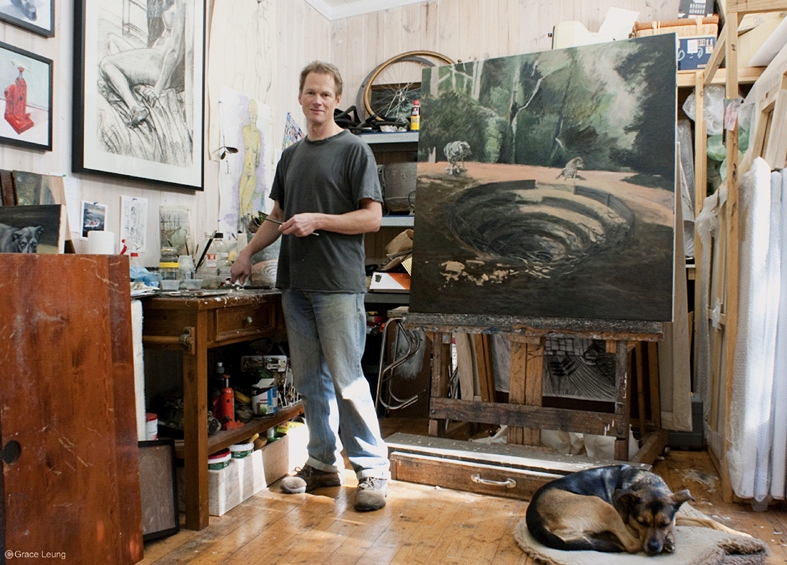
My language is paint. I speak through the medium of paint and ink, pencil and pastel. This is a language I am always learning, a language of challenge and a language of love, where I try to express my thoughts and responses to the world around me, bear witness to the actions of mankind and the wonder and beauty of the land.
This land speaks to me, speaks of its ancient presence, of the justice and injustice it has witnessed, the rich oasis that was ours to nurture. We ravaged it, murdered and displaced its indigenous peoples, poisoned it with chemicals, tore down the trees and made extinct so many of its animals, plants and insects. The land gave to us so that we would take what we need, not more. Now we face our own extinction.
Painting is a passion and a refuge. My hope is that I have something to say and something to give, that I can be heard and can communicate through the language of my paint.
Originally from the west of Ireland and living in Sydney, Anne Casey is author of two poetry collections—where the lost things go (Salmon Poetry 2017, 2nd ed 2018) and out of emptied cups (Salmon Poetry, 2019). Anne has worked for 30 years as a journalist, magazine editor, media communications director and legal author. Her writing and poetry rank in leading national daily newspaper, The Irish Times’ ‘Most-Read’ and are widely published internationally—The Irish Times, Entropy, apt, Murmur House, Quiddity, Barzakh (State University of New York), DASH (California State University), FourXFour (Poetry Northern Ireland), Cordite, The Canberra Times, Verity La and Plumwood Mountain among others. Anne’s poetry has won/shortlisted for awards in Ireland, Northern Ireland, the USA, the UK, Canada, Hong Kong and Australia. She is Senior Poetry Editor of Other Terrain Journal and Backstory Journal (Swinburne University, Melbourne) and sits on numerous literary advisory boards.
James Walton was a librarian, a farm labourer, and mostly a public sector union official. He is published in many anthologies, journals, and newspapers. He has been shortlisted for the ACU National Literature Prize, the MPU International Prize, The William Wantling Prize, the James Tate Prize, and is a winner of the Raw Art Review Chapbook Competition. His poetry collections include The Leviathan’s Apprentice 2015 Publish and Print U.K., Walking Through Fences 2018 ASM & Cerberus Press, Unstill Mosaics Busybird 2019, and Abandoned Soliloquies Uncollected Press 2019.
Davide Angelo’s poems have appeared in Cordite Poetry Review, Overland, WA Poets Inc, Visible Ink, and elsewhere. In 2019 he was awarded Second Prize in the Melbourne Poets Union International Poetry Prize, long-listed for the University of Canberra Vice Chancellor’s International Poetry Prize and received a Highly Commended in the Ros Spencer Poetry Prize. He lives in Bendigo, Victoria.
UNFURL is a publishing and social media project in which writers and artists distribute their work and reach new audiences by combining the power of their social media contacts.
Each UNFURL number (or edition) is an independently hosted web page—and that web page is linked to the UNFURL website where all the contributors’ biographical info is maintained.
UNFURL is free for readers and contributors. It costs you nothing to distribute or for readers to read.
Writers and artists who contribute co-operate to promote each other by offering to use whatever means they have to distribute the URLs of each edition as they become available. That could be as simple as sharing the link on your Facebook timeline, Instagram feed, website, or Twitter.
Each time a new edition of UNFURL is released the network of social media contacts widens.
Keeping UNFURL alive expands the audience for your work.
There will be new editions of UNFURL now and then, depending on how long it takes for contributors (and UNFURL editors … yes, it is possible there might one day be more of them) to herd all their cats. There are no deadlines.
When you are invited to UNFURL you will also be invited to a Facebook contributor group. There’s information and discussion in it you may find useful. However, the basics are outlined here.
If you do not have a Facebook account, essential information is also sent to your email address.
It’s self-curation, people
You decide for yourself what you want to publish.
You can assume the only constraints are the editor’s time, and your work’s legality and decency (the last being a fiction entirely in the editor’s mind).
Occasionally the editor may try to prevent you making a mistake, and how things work out will depend on how you respond to friendly advice. You must approve of your contribution.
For visual artists of any kind UNFURL is straightforward. It’s about images, still or moving. You have options.
For complete personal control over the content, you could ‘host’ (or publish) all images yourself and UNFURL will simply link to your content.
This could be your website, or your Google Drive folder of photographs, or your Flickr account. You just need to keep in mind that if you manage it this way you have decided to opt out of the integrated presentation of images that UNFURL is offering to you.
In this case all UNFURL needs is an artist statement, biographical information, a photo of you, and the links to your work.
Video art stays on YouTube or Vimeo and is embedded in UNFURL.
If you want to create a gallery in an edition of UNFURL, gather your images together and prepare them in the following way:
Make the images as small as possible to display properly on a laptop or tablet computer — about 1200 pixels wide (at 72dpi) is usually enough.
Use a ‘lossy’ and compressible format like .JPG.
If possible, put a very discrete watermark on your images. (This helps to protect you against unauthorised re-use.)
Name the files with the title of the work, a date (year), and your name. Add the dimensions of the work, if you wish, or if you think it is relevant.
This is the format:
Title of work (medium, dimensions, YEAR) Artist’s Name.jpg
When UNFURL captions the work, the work’s title will appear in italics, exactly as you have named the file. UNFURL simply drops the “.jpg” from the end.
UNFURL hosts a document that contains your writing and biographical information.
UNFURL maintains the document in a format consistent with other writers.
Achieving this requires documents to be made with a Word template that uses automated styles to apply formatting to the text. If you are not used to doing this in Microsoft Word, or with working with Word online, the UNFURL editor will assist you.
Create a text document of your own in whatever program you use for writing. (If you use a typewriter, congratulations and UNFURL will scan your pages and publish the images.)
Make sure that document contains only basic formatting—i.e., bold or italics—and is preferably an RTF-type document (rich text format).
You can send this document to UNFURL, or
Cut and paste all the text you want to publish into the online document that UNFURL will embed directly into the edition in which your work will appear. You access that online document through a link that the UNFURL editor sends to you.
If your writing contains complicated or fancy indenting (Go, poets!), do that last and in the final document.
Microsoft Word cannot do everything. If you are imagining something ‘different,’ speak to the UNFURL editor and an attempt will (probably) be made to accommodate your pernicketiness.
You will get to proof everything before it is published.
For the time being the document you create will not be embedded in the UNFURL in which you are published. Instead, a link in the UNFURL will open a PDF that can be read online. UNFURL hopes that embedding will be possible in future.
The editing process for writers sometimes includes collaborating on an online version of the document to be published by UNFURL. It’s an uncomplicated way to work and exchange questions on a document without passing versions back and forth.
If the editor sends you a link, it will open in a browser and will save itself automatically when you make changes.
The online document appears slightly different on-screen than on paper. To view how the document will look if printed (or as a PDF), click on “View” in the menu bar …
And then click on “Reading view” …
What then?
You’ll be invited to join a Facebook ‘unfurl contributors’ group. If you are on Facebook, please join.
If you do not have a Facebook account, congratulations. Stay connected through email — ‹unfurleditor@gmail.com›.
Distribute the links to unfurl editions as they become available.
Each new edition will have links to the previous editions, or to the UNFURL home page, so your contribution is not forgotten.
Your contribution is listed at the unfurl home, and on various other sites, like linktr.ee, ‹https://linktr.ee/unfurl›.
Every unfurl has its own bit.ly link so we can count readers and follow where those readers are.
Use those links to promote your writing and art through your social media, your website, or even just by sending the link to your friends by email.
You can link directly to your section of the UNFURL in which you are published.
Every UNFURL has links to every other edition of UNFURL, so the work you have done to contribute to the publication always pays back. At the very least, your work remains in front of readers and the links in your ‘bio’ continue to provide a new avenue for readers to discover your work.
Distributing UNFURL is easy. Each edition has a link, and a related group of constantly updated reference pages on the web.
UNFURL uses bit.ly links so we can count how many people are reading your work.
The contributor Facebook group will publish links to each edition and other materials you can use.
You can put these links in Facebook posts, with your own recommendation or with the few words provided in the Facebook contributor group.
If you do not have a Facebook account, the links will be sent to your email address. (The emailed information is sent to everyone anyway.)
Use Twitter to distribute the link. Add a few relevant hashtags, and/or send it directly to people or groups you think may find it interesting.
Instagram is not a highly effective tool for working with links, but it is worth a try if you have an account. Use one of your own graphics, or one from UNFURL, and put the bit.ly link in the first comment, along with appropriate hashtags.
You can use your own email contact lists to send the UNFURL link to your friends and family.
You can put the UNFURL link on your web page, in the bio section, or listed as another place to view or read your work.