Category: UNFURL | content

An item that is to appear in the NEXT UNFURL issue.
(Cleared after each issue.)

  • Dominique Hecq

    Dominique Hecq

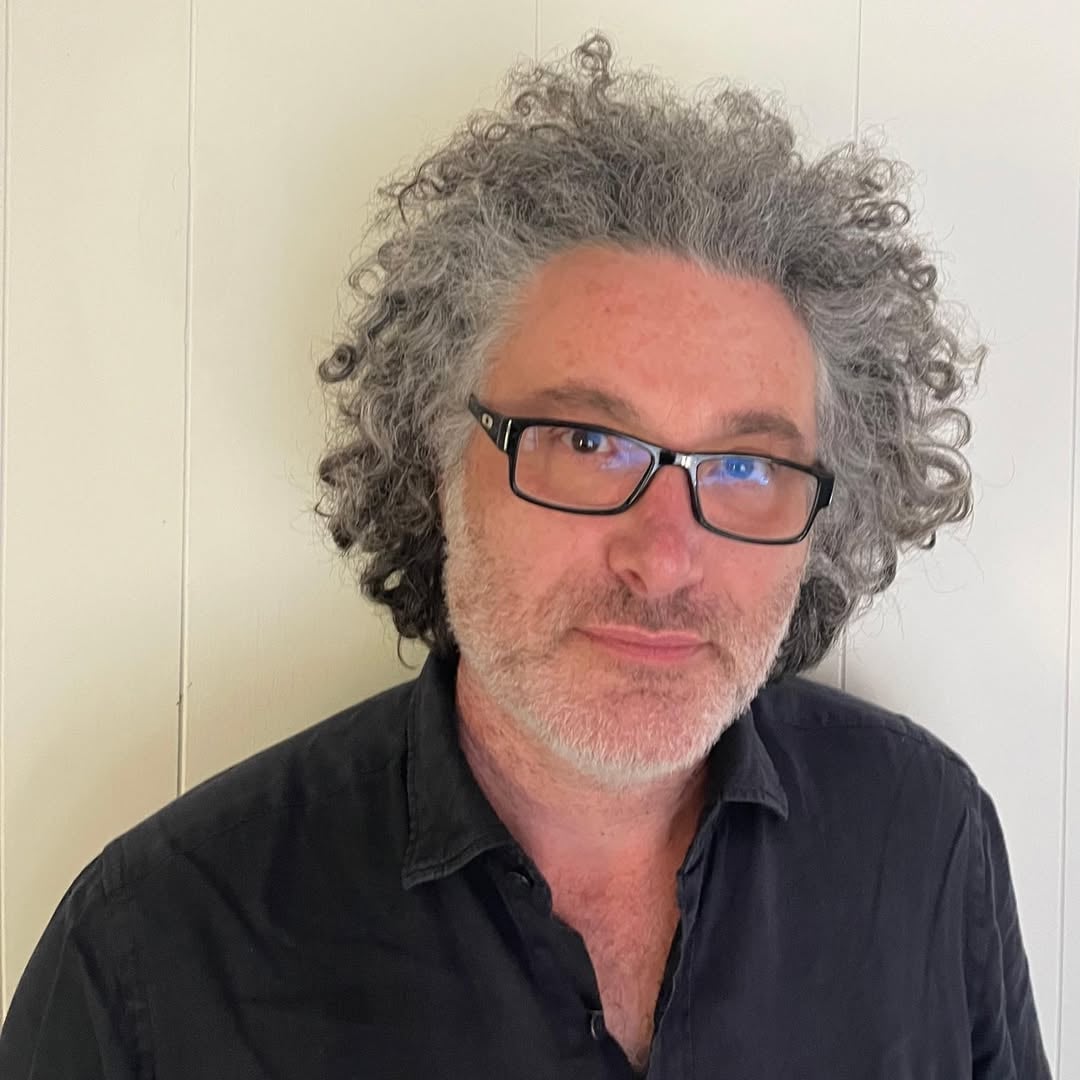
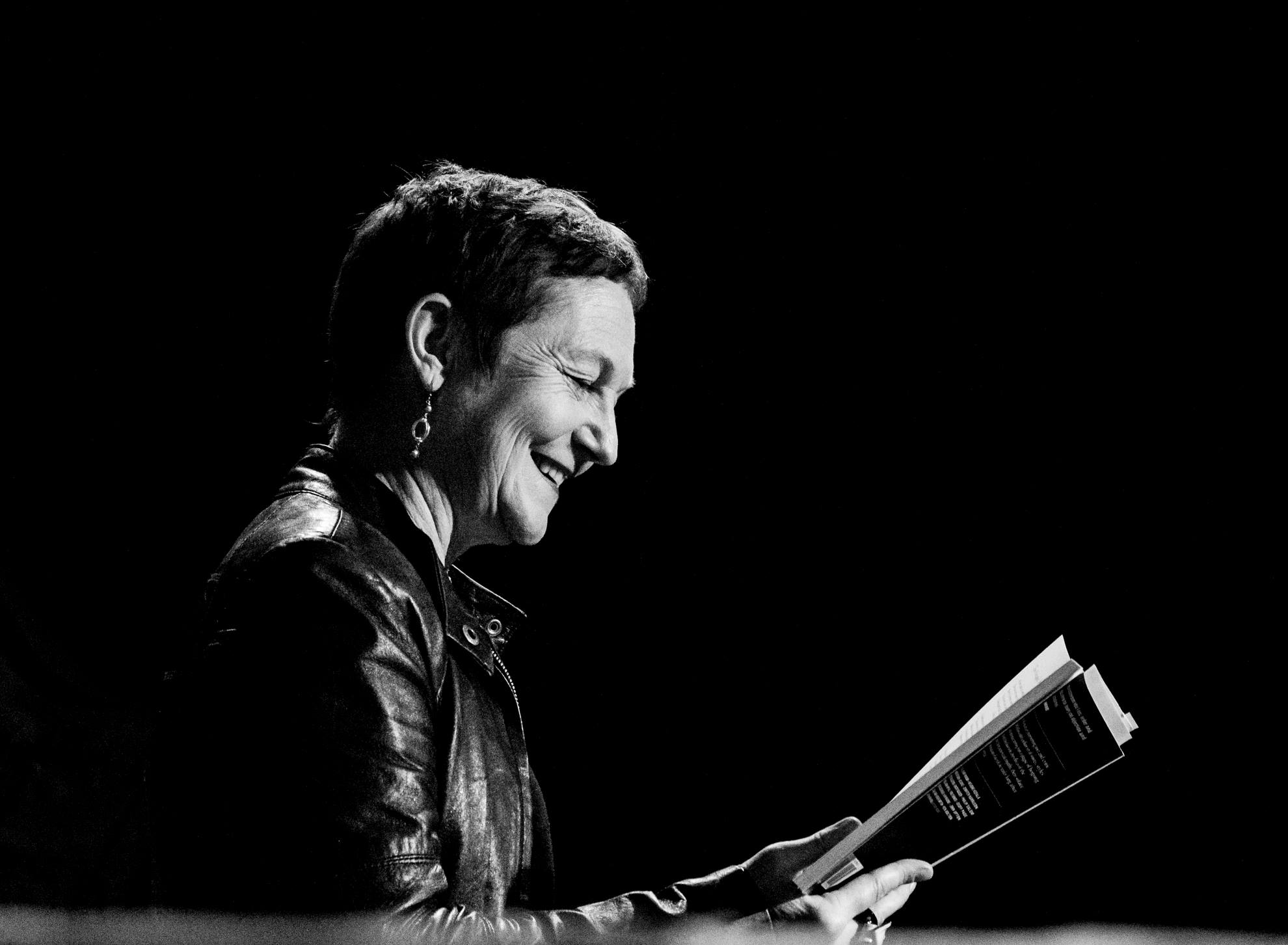
    Image: Dominique Hecq (photo, 2019) Bendan Bonzack

    About Dominique Hecq

    Dominique Hecq is a widely anthologised and award-winning poet, fiction writer, essayist and translator. She lives and works on Wurundjeri Woi Wurrung land. Hecq writes in English and French and sometimes across languages. Her creative works comprise a novel, six collections of short stories and nineteen books of poetry. Errances (Recent Work Press) has travelled the world in 2026. She is currently writing a lyrical essay titled ‘Unleashed: My Life as a Dog’, a love poem to Artaud, a Kelpie. This may be a kind of farewell to Jacques Lacan.

    Among other honours such as the New England Prize for Poetry the Martha Richardson medal for Poetry and the Carmel Bird Digital Literary Award, Dominique Hecq is a recipient of the International Best Poets Prize administered by the International Poetry Translation and Research Centre in conjunction with the International Academy of Arts and Letters, and the James Tate for poetry.

    Walking the Dog

    Artaud (2026) Fawn Colosimo Pavano (fawn.col.pav)
    Artaud (2026) Fawn Colosimo Pavano (fawn.col.pav)

    Genesis

    … a manner of mosaic-memory
    —Nicole Brossard

    Pick up the day by the scruff of the neck
    homecomings have sharp teeth

    though ignorant of meaning they bite
    taking puppy fat          for puppy love

    and dark      soft     words
    melt in ink swirl you call
                               survival

    drop by drop it is
    your very self reflected and gathered
    as dark as breath  when it sneaks out
                                        between fangs

    under the cross-eyed sun
    so hot        you       creep 
                                     inside

                                      scribble at large
                                     of interstellar
                        encounters

    Kaosmos, MPU: Melbourne, 2020, p. 3.

    Unleashed: My Life as a Dog

    … I tried to make the face that spoke to me tell / the secret
    —Antonin Artaud

    I’m three. Little monkey jumping on my bed. Home alone. I’m getting a dog with goldilocks and floppy ears and no tail. Boucles d’or. High high high I jump. Oh, so high.
    Car doors clang shut. Here they come, now. Papa et maman. With Peggy! C’est maman qui a choisi le nom, says papa. Oh non! Boucles d’or.
    That’s all there is: all of Peggy Lee traded for Goldilocks on my birthday. And Peggy for mummie. C’est trop injuste. Such dejection unleashed.

    At the RSPCA we wait for RG, a Kelpie. He’s got scruffy black hair, golden coins for eyebrows, a deep frown. RG scampers over to me like he knows me. A lick, tentative. I walk him out into the paddock on a slip on leash. He darts hither thither, hither thither. Sniff sniff sniff. We sit in the visitors’ enclosure. He wags his tail close to the ground. He’s all bristles when other dogs bark in their cages.
    Congratulations says Hetty at the desk. RG’s from a farm. He worked sheep. He’s very timid. I try a pat. RG cowers. Only a scratch under the chin, says Hetty, like this. Hetty demonstrates. This will require a lot of patience.
    Can I change RG’s name? I ask timidly.
    But of course, it’s part of the fun of rescuing a dog. What will you call him?
    Artaud
    . ARR-TOH.
    Hetty updates RG’s details on his file. I’m surprised to see my father’s name next to Artaud. Ponder the word rescue.
    I purchase a harness and a long leash. Orange. It looks good on Artaud’s coat. To the car. Luke’s our chauffeur, now. Artaud hops in the boot, unprompted. I sit in the back, dangle my hand across the seat to reassure him. He soon falls asleep.

    Spring feels like fall. I drop baby potatoes in holes my father digs. Plop plop plop. I’m bored. I know Peggy’s waiting for me in the laundry. I sneak in. We roll on the tiles. It’s cold. Peggy’s eyes are sad. I totter to the sink. Reach for my mother’s make-up case. Grab her coral lipstick. Viens, Peggy I say, luring the dog into the toilet. I lock the door. Paint a smile on her lips. She’s all smile now!
    Footsteps. Heartbeat a stampede: I can’t unlock the door.
    Dominiiique?
    Ouiii?
    I do as instructed. Slip the key under the door. Free!
    Ma fiiille, says maman—My girrrl, as she furiously pats Peggy. Not a glance at her real daughter. I feel abandoned, again. Replaced by a bitch.
    Qui est-ce qui a fait ça ? Roars Papa. Who did this?
    Un p’tit peu moi-a, un p’tit peu Peggy. A little bit me, little bit Peggy.
    Au coin, says father. I am banished, again. Corner time out.
    I see pink. The walls are papier rota, freshly painted. I’m dizzy. Something breaks. Love is scary. I hate aller au coin. It feels like a million years. Au coin I practice unfeeling. I renunciate love.
    It all comes back to me à soixante piges—at sixty! The baby pink. The mixture of guilt and shame. The sense of abandonment and banishment.
    Strictly speaking I was not abandoned. One is abandoned where there is a relationship based on a recognition of difference. There was no such recognition. I was just an extension of my mother. J’étais sa perruque, I was her wig, her hair extensions. Later I will realise that she resents me. Envies me. I became the coral absorbing her envy.
    It all comes back to me à soixante piges. The mixture of guilt and shame. The little white socks scampering to school past farmhouses and barns, le petit magasin du coin, the little corner shop where I’d buy cherry lollipops that made my tongue red quiet, the hairdressing salon releasing beehive coiffes and the tall trees with yellowing leaves and the suppressed feeling of being banished. Love is scary. My academic success is contaminated by guilt and shame and envy and my father’s impossible demand. In my head he commands me to jump higher and higher. I’m a monkey doomed to fail. At school I say that I have no father, knowing full well he’s doing his delayed military service.  I sense that he has to pay for my insolent arrival into the world. I banish my father.
    Twenty years later, I flee. Banish myself from family, church, country. A rolling stone gathers no moss.
    Banishment: an attempt at separating oneself from the august and placid expanses where the father’s sublime Death, and thus Meaning, merges with the son’s ‘self’, writes Julia Kristeva, (but where a daughter can very easily become trapped), mummified, petrified, exhausted, ‘more dead than alive’… So flee this permanence of meaning. Live somewhere else, but in the company of paternal Death.1

    Artaud runs in his sleep. His little feet make darting motions. He coos and whines and whimpers. He dreams of sheep. Of fleeing, maybe.
    At break of day I glide downstairs to check on him. He’s vomited his dinner. Chewed his harness. He looks mortified. Recoils and trembles as though he thinks I’m going to hit him. Artaud le Momo, come outside, I say. No one likes being sick. He follows me. Stops in the doorway. Come, boy, come.
    Artaud is an anxious dog. He is scared of Luke. He is scared of all blokey blokes. Heavy steps. Loud noises. Sudden movements. Brooms, towels, the washing basket and Mr Hoover.
    I pet him on the head, now. Tell him I love him.
    To love is to survive paternal meaning. It demands that one travel far to discover the futile but exciting presence of a waste-object: a man or woman fallen off the father, taking the place of his protection …2
    I don’t like Julia’s suggestion, though I suspect I did just that, fleeing from one hemisphere to the other. Away from the primal father and his woman, maybe?
    Artaud as father substitute. My totem, as Sigmund Freud reminds me.3 I don’t like the idea either.
    Let’s go for a walk, Artaud. I’m a trainer now.
    Hither. Thither. Hither. Thither. Is it Artaud or me pulling on the leash? Hither. Thither. Snif snif snif. Il était une maitresse qui promenait son chien. Elle avait dans sa tête de vraiment drôles d’idées. Sa tête faisait rouli roula. Sa tête faisait rouli-roula. Deux pas en avant. Deux pas en Arrière. Deux pas d’un côté. Deux pas de l’autre côté. Artaud, Momo, we’re not moving. Backtrack. Walk with me. Artaud sniffs the air now. He smells tons of things I can’t smell. Sees so much more, too. He’s on high alert. God, I love him. At the playground a woman barks: Are you walking your dog or is he walking you? The latter, I answer. God I’m hopeless.
    Keep up, Artaud.
    Now, that is strange: RG, my analyst’s initials. Artaud is my analyst now.
    The term 'transference' first appeared in Freud's dream book with reference to the displacement of affect from one idea to another.4 Later, it came to refer to the patient's love/hate relationship with the analyst as it develops in the course of the treatment. Jacques Lacan argues that though transference often manifests itself in the guise of strong affects such as love and hate, it does not consist of emotions as such, but of the structure of an intersubjective relationship.5 In The Four Concepts of Psychoanalysis Jacques articulates the transference with the Subject Supposed to Know, which I’d rather translate as Supposed Subject of Knowledge. According to this model, transference is the attribution of knowledge to the Other, the supposition that the Other is a subject who knows: 'As soon as the subject who is supposed to know exists somewhere … there is transference.6
    For Jackass Lacan, however, this Supposed Subject of Knowledge need not be a physical person. This subject may indeed be a body of work—like this text. This implies that transference can manifest itself with reference to three instances of the Supposed Subject of Knowledge in ‘Unleashed’: the author, the work and the reader. Or the author, the work and Artaud.
    Oh, you may object, dear reader, but Artaud is not part of the Symbolic. Artaud is a dog.
    Yes, but he communicates other-wise. Besides, he knows things I don’t. Here comes the rain…
    Jackass says that many animals speak in a sense when they are in pain or in need: You have only to observe a pet to see that a being deprived of language is quite capable of making calls on you, calls to draw your attention to something which, in some sense or other, it lacks.
    So, animals can articulate a demand. But they lack access to the dimension of the signifier. If I say sit, Artaud sits. If I say spit. Ditto. If I say Sss he now sits. Does that mean Artaud lacks access to the symbolic means through which my reality is constructed?
    Let’s go for a walk.
    Artaud saunters all over the place. Sniffs all over the place. Pisses all over the place. Now he lunges at a fluffy designer dog. Now I pull the leash. He pulls and I pull now. I am frustrated with Artaud, the wandering analyst who does not look at me.
    Sorry, Artaud, I say when we get home. I need some time out. I release him in the backyard. Artaud snorts.
    It suddenly occurs to me that Artaud doesn’t bark. None of Antonin’s mots-souffles / breath-words or mots-cris / howl-words. It suddenly occurs to me that this language obsession of mine is a pathetic fantasy. The fantasy of a dog named after a poet who understands human language is nothing else than the fundamental fantasy: the unchecked connection with the Other.
    Sit Artaud.
    Shit Antonin.
    I resolve that Artaud will never attain the status of parlêtre. Nonetheless…
    Nonetheless, Artaud dreams. Nonetheless, Artaud doesn’t bark. If I analyse these two statements, deep down I ask whether a dog has an unconscious and whether there is something wrong with an Artaud who doesn’t seem able to articulate a demand.
    This will require a lot of patience.
    Jackass stresses that all speech is a form of demand—specifically a demand for love. And yet Jackass also notes that despite the universality of language, or the dimension of the symbolic, human beings are prone to méconnaissance, by which he means, to misunderstand each other. So, it seems that I mistake a bark for a word. Ah, l’Amur!
    Let’s go for a walk.
    We go to the cricket ground. It’s fun. Scary: Artaud doesn’t know what to do with other dogs, except other so-called working dogs. He nips a designer dog. It’s getting complicated. I step onto unbeaten tracks when I say yes, I’m the dog’s owner. I enter ontological pathways that conceptually and socially and legally construct the person I am when I say the word owner.
    This f…ing dog is f…ing dangerous. You should never take him off the leash yells the other owner who has kicked Artaud. Hard. And who now pursues us: if your dog attacks my dog again I’ll f…ing kill him. I keep up, shaking. Good boy. After all Artaud only defended himself. Or warned the designer bitch that bit his ear first.
    High five, Artaud!

    Axon, Vol. 15, 2023.

    Otopos

    1.

    Lulled by the night’s lingering breath, the city hibernates. Funnelling wind at your back, you skirt the creek. Follow the trickle of bruises the light leaves in its wake. You take the path down to the bridge, the no-sun enfolded in fog. Eucalypts rustle. Reeds rumour. Australian wood ducks, chestnut teals and a lone hardhead on corrugated water. Magpie larks chatter in a she-oak. A nankeen night heron darts in your path as if to say you don’t exist. Under the bridge, a black swan on a nest intermeshed with plastic. Now the wind embraces you. Mud sucks at your boots—ssk ssk ssk. Rainbow lorikeets, fairy corellas and musk lorikeets clatter about. You climb the escarpment. Here, creeping bent grass, English broom, arum lily, prickly pear, periwinkle overflow garden fences. Gusts of wind through veils of bridal creeper and poison ivy.

    2.

    Walk with me, says the voice drowning in its own rasping sound. You become it, the voice, a shapeshifter like the creek itself, brimming with unspoken thoughts, voiceless bubbles, breathless refuse.

    Waterfall. Murky calm where the path tilts and narrows.

    Here, the water curves and swerves in its owns bed, pulls at silt. The current pushes it out unseen, against the sunken stepping stones.

    Here, the water swirls, froths, falls and rushes towards the edge land of daydream. Towards the immargination of the page.

    3.

    A wattlebird babbles on the other side of the window. I replenish the water bowl. Spot a honey eater hopping about in the fuchsia.

    My hand yawns. It is a beak opening.

    Water breaking at the touch of a feather.

    I am a magpie. Warble a wattlebird prattle.

    I feel for the shape of a poem.

    I live and work on the land of the Wurundjeri people of the Kulin Nation, the sovereignty of which was never ceded. I acknowledge its traditional custodians, offering respect and gratitude to their ancestors, elders and families past, present and in perpetuity.

    Australia always was and always will be, Aboriginal land.

    I feel shame, not quite guilt, for knowing so little about the languages, cultures, and customs of the Kulin Nation. For purloining the bird’s call. For naming it prattle.

    (To unwrite the I from the poem. Think of it.)

    4.

    Words are possums crawling up the walls of silence. They have razor-sharp claws. They pounce. They can see in the dark. They will poke the apple of your eye. Hook your mouth shut. Rip you to shreds. Tear up your dreams one letter at a time.

    Pause.

    Consider the damage to the root of your tongue.

    Don’t worry: they will burst the blisters tenderly. At dawn they’ll scuttle around the idea of noise. Then they will burrow under the vault of your ribs and nibble at the chambers of your heart.

    Here, they will persuade you to shrug off your graphomania, glossolalia, xenolalia. Tendency to anaphora and… apocrypha.

    5.

    Cold bites, breath dissipates
    gossamer mist nudges the windowpane.

    Sky low over Melbourne.

    The sun wears a corona of grey that keeps it away
    from the day
    like a foreign body’s swathing
    so intimate it blinds.

    I fumble for the shape of a poem.

    Pelting rain. The wind dies. Ink spills.

    This is how the I unwrites itself from the poem.

    The sky won’t fall for all its broken lights.

    Waves of wheeling spectral spokes follow
    you like a sailing dream.

    Open the window.

    Float past your life.

    You could go along a straight line for light years;
    the angle at which you’d see sun and moon
    and shade and sea would be the same.

    This is how you unwrite yourself from the poem.

    A boat loaded with broken mirrors sets alight
    memories of a past for live masks.

    A boat loaded with dry brambles lights nightmares
    of a present for death faces.

    A boat loaded with paper aeroplanes matches
    dreams of a future for unborn forms.

    On the nearby shore, ash of us in shimmering shadows.

    6.

    Another lockdown. Your pen interrupts
    itself half-way through a line. You hug
    the sky. Come out of hiding.

    The lounge is littered with photo paper,
    twine, sticky tape, a notebook, bubble
    wrap and four phallic sculptures lying
    on their sides.

    The kitchen is a tapestry
    of left-overs on plates that don’t match.

    The bedrooms are full of humans, their
    avatars, screens and keyboards.

    Lambent light beckons. You steal
    out of the house in search of a poem.

    Skitter down to the creek, anti-clockwise.
    Climb the rocky escarpment
    past the rickety bridge.

    Bees and honey eaters in fire sprite grevilleas.
    Dogs and people everywhere. Wattle
    in the air. Sound of a bagpipe.

    You cut across the wetlands. Survey
    the plants: tussock grass, paper
    daisies, spear-grass, everlastings,
    orchids, lilies, periwinkles, maidenhair.

    Your heart leaps at the sight of the scarlet
    runner, and the word turns where it means to go.
    (Unwrite the I from the poem.)

    Otopos, Beltway Editions: Rockville, US, 2024.

    The Doors

    The regulating line is a guarantee against wilfulness
    —Le Corbusier

    i.

    The house rocks like a boat tugging at its moorings. Inner weather, gusty. We’re playing dead fish. Mike Parr’s ‘Head on a Plate’ regards me. I stare back. I’m gone with the wind, gills and fins fluttering. Disappear the golden orb spinning its silk threads in cirrhus clouds branching against the sky. Unstick myself from the idea of arachnophobia and away from the viscid spiral of sticky thread joining windowpane to Parr’s etching. The head is distorted. I blink off the shadowed eye sockets. Squint. With a slight adjustment of perspective, I catch sight of an anamorphic skull: punKtime. Death brushes past. We are The Ambassadors now, waiting for Godot. Maestro strides in through the lounge’s butter doors. Opens the baby grand’s lid. Fingers scurry on the keyboard. Hammers hammer strings. The floorboards shake. Walls are reefs. I’m a jellyfish. Starfish. Rock fish. A rolling stone that doesn’t know what it sways. God, ready? Nose aloft, the dog holds my gaze. Roll. Left. Right. Left. Right. Turn and toss. Fur and silk ripple. Passage of blazing light as backdrop. Melting butter. We are The Doors now. Heterodogsia, unsinging the dance. Körperbild. People are Strange, my dog. Rock!

    ii.

    At night, when silence trembles with echoes and moonshine bobs on the floorboards casting shards of shadows on the walls, we leave them open to the dark, the doors. To terrorise the Architect who looks down upon this phantom world in ille tempore. Because all life holds its own destruction and God is nothing but the arbitrary distinction between heaven and earth, left and right, margin and immargination. Cut, not suture. Kinetic poesis. No beginning, but rhythm, repetition, spacing, caesura: difference from self. Dog centre. Repercussion, resonance, reverberation, resounding, revenance, reflection, return from within difference. Humans or otherwise, we are constituted by rhythm. This caesura sentence which gathers and segments and which means that every single thing can be danced like a prose poem unleashing the rules of lexis, grammar, syntax. In ruffle reef light, fur and silk ripple and brush. Time is paradoxical … it folds or twists; it is as various as the dance of flames in a brazier, here interrupted, there vertical, mobile and unexpected. Because we are truly fickle matter existing. Already exiting. Rocking the boat to the breath of time.

    Dancing about Architecture, Cassandra Atherton & Oz Hardwick, eds.
    Mad Hat Press: Cheshire, US, pp. 196-97.

    The Ear in the Heart

    When I close my eyes & stumble
    around my thoughts      I see
    everything I love is outside
                             language

    A dog's beating heart underneath sleek fur
    the swift dispersal of lorikeets
    a child's crackling laughter
    Ravel's music & devastating silence
    Khalo & Basquiat's loudness

    Each night I return
    to pilfered forests           parched billabongs           hounded
    brumbies           furrowing clouds           light’s utterances
    fireballs & storms           forking paths           autumn
    catching fire & the stench of soaked pelt

    In each belated dawn      rhythm is
                                                     unforced

    I love the smell of ink washing over me      the feel of paper
    I crave the dark for its stillness           peripheral
    phantoms

    Even though I know them           words do not know me

    Words and I no longer share the same lexicons

    Letters wild      vowels discordant      consonants harsh

    The alphabet is      shapeless       scratching      litter

    Through the riddles of words      death shimmies       sometimes smirks
    but its grimace may not be short       lived

    I once found myself in another tongue

    Now I uncover myself out of language     
    for words know neither body nor the ear in the heart

    I find myself in the pulsing arteries of existence

    Language is a pyre
    my lungs thirst for air
    sucked out from them

    I hanker for breath      feel for the shape asleep by my side
    stroke the coat coming alive in breaking light

    Magpies erupt into trills

    The dog stirs      swivels his head      surveys my face
    I inhale      offer a caress      & together we rush      into the roaring wind

    Live Encounters, Vol. 17, 2026.

    Passing through

    Wherever you come from
    or are—
    with no margins

    uprooted or not
    you only ever write to prove that you exist.

    In doing so, you lose yourself

    empty yourself

    dispossess yourself

    destroy yourself

    re-craft yourself.

    Only nothingness signifies everything.

    It is from loss that you draw your strength.

    You pulled at your moorings
    moved on
    transgressed.

    All the while knowing that one never leaves.

    Yours is a borderline, insular, precarious, ambiguous predicament:
    you keep on displacing the horizon.

    Cri et silence

    You are made of particles in time and space, so only truly become yourself in your relationships with others. With leaps into gorges within these very relationships. At the source of all life, which is essentially the other. And which allows you to be yourself and more present to others.

    You who also have a dual allegiance as human: to life and death; to time and eternity; to murder and life; to time and eternity, to the unconscious and consciousness. A dual allegiance compounded by your sex: you can give life, but also take it away.

    In this world in which we live and which, in its very convulsions, is already that of tomorrow, what is required of us in the first place? If not to work towards the advent of this relationship between oneself and the other. To write.

    Errances, Recent Work Press: Canberra, 2026.

    Footnotes

    1. Julia Kristeva, Desire in Language: A Semiotic Approach to Literature and Art, New York: Columbia University Press, 1980, pp. 149-50. ↩︎
    2. Ibid., p. 150. ↩︎
    3. Sigmund Freud, ‘The Devil and the Father Substitute’, The Ego and the Id and Other Works, The Standard Edition, Vol 19: 1923-1925 [1922], p. 87. ↩︎
    4. Sigmund Freud, The interpretation of Dreams, Harmondsworth: Penguin Freud Library, Vol 4, 1982, p. 562. ↩︎
    5. Lacan, Jacques 1951 ‘Presentation on Transference’, Ecrits (trans B Fink), New York & London: Norton, 2006, pp. 176-89. ↩︎
    6. Lacan, Jacques 1965-66 Le Séminaire. Livre XI. Les Quatre Concepts de la psychanalyse (ed J-A Miller), Paris: Seuil, 1971, p. 232. ↩︎

  • Philip Hammial

    Philip Hammial

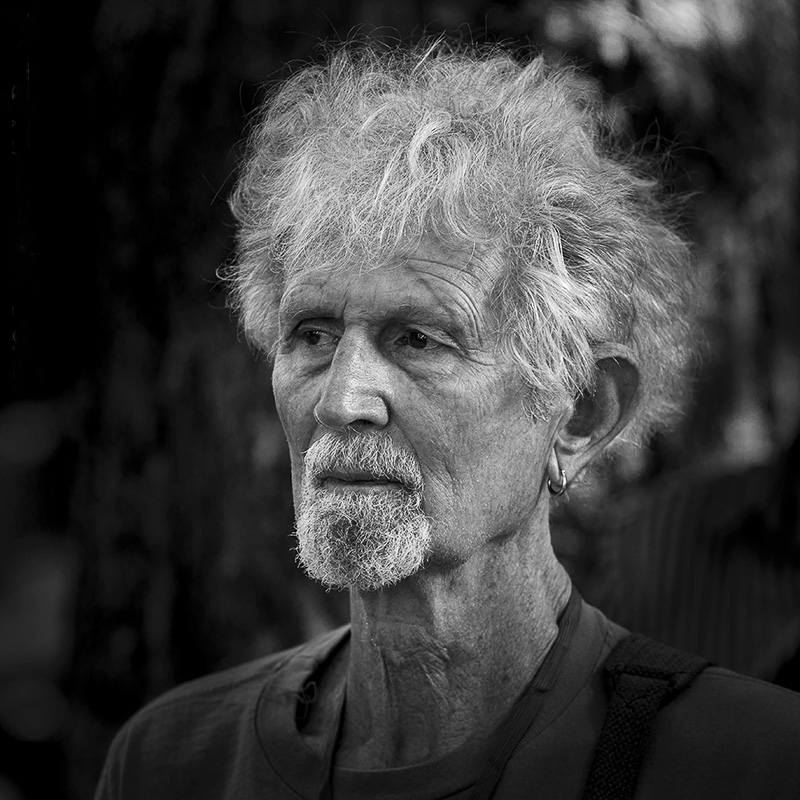
    Photo: Philip Hammial (2016 © Сашо Димоски-Sašo Dimoski)

    Biography

    Born & raised in Detroit, the D, Motown, the Motor City, a high energy city that’s nurtured a thousand world-class musicians—blues, R&B, soul, rock, hip hop, jazz … especially jazz: Yusef Lateef, Tommy Flanagan, Barry Harris … Teenage hood, 4 Ford V-8s, a Rocket 88 Olds. 3 years in the engine rooms of 2 U.S. Navy ships. University on the G.I. Bill, honours in English Lit & Philosophy. A total of 11 years travelling in 85 countries, the first 5 hard-class, hitchhiking around Europe, through the Middle East, India (know anyone who has hitchhiked in India?) SE Asia, Japan, Africa (hitchhiking: Nairobi to Cape Town, 7 days in a truck, Nairobi to Juba). Arrived in Australia in 1972, became a citizen as soon as dual-nationality was okay with the Yanks. More travel: India 5 times, China 4, Tibet 2 (a dream come true) Africa 6. Hospitalized in 5 countries, 11 broken bones, brutally attacked in rural India by 17 young men with hard wood sticks, saved at the last moment by a train station master & a saddhu. 4 near-death experiences. Volunteer fire fighter with the local bush fire brigade, 8 years. Vintage BMW motorcycle. Favorite sport: hopping freight trains (U.S.). 6 months as an orderly at a psych hospital (Ohio). 90 days on the Lincoln Continental assembly line, Detroit. 40 published poetry collections, 2 short-listed for the Slessor, 1 for the ACT Poetry Book Prize. A selected from Sheep Meadow in NY. Poems in 38 poetry anthologies in 7 countries, in 140 journals in 18 countries. 14 international poetry festivals. Australian writer-in-residence for 6 months at the Cité Internationale des Arts in Paris. Director of the Australian Collection of Outsider Art, 26 exhibitions in 5 countries. A sculptor, 33 solo exhibitions; in 78 group shows, 2 in Paris. Now: a boring old man with too many stories.

    —Phil Hammial

    Poems

    Voice Snags

    Did you notice the red-headed Christmas monk
    on the runaway people-mover? No. Where we go
    no gifts go. On that you can depend, i.e., you can bet
    your sweet ass on it. They came as one (who?) left
    as twenty-seven. Seems we were three too many.
    Your choice of career moves
    —slip or slide. Which came first, scrutiny or jam jars? Bossa Nova
    is my go-to. For? Whatever. You forgot to factor in
    the gee whiz equation. Why have you chosen
    to live in a box (the English language canon)?
    So contained, may your wisdom prevail. A chance
    in ten thousand by my reckoning. At
    the Governor’s pleasure he stood by guns
    (in the hands of Slessor judges). No sooner on
    than off, the emphasis. Some say that the laureate
    specializes in right-handed scams. Even
    buxom friends betray. Against all odds
    he managed to ring the bell. He licked the mike,
    thought it was an ice cream cone. He tried the
    he’s-just-having-a-fit approach. It failed
    miserably. Water dumps D.O.A. Just as well
    they don’t have teeth. We could make a heist movie.
    I’d rather make a live chat. He’ll only be seen with us
    if we don’t make fun of his painted nails. At his best
    he’s a Nelly on a porch. At his worst … the guy
    with the stop-watch timing our squeals of joy
    when the limousine with the polies takes a flip
    flop, becomes a panel-beaters dream come true.
    True or false?—septic shock can kill. This war
    is not the main game. A mother load
    is easy to bear. Daddy Longlegs? Obviously
    he’s put a spell on her. Can we persuade him
    to take it off? Easy done, get down on your knees
    & polish the shoes on those feet. Did
    you happen to notice how Lenny defended the rights
    of the lap dancers at Chez Parakeet?

    Party On

    Payola’s stem guy misbehaving at Miss Angelica’s
    coming-out party, a closer look revealing that it’s just
    another cup & saucer escapade. Me? I wasn’t
    in the Gloria Gaynor crowd, if only I had been.
    Gloria, please sing the Albatross Song. I shall
    eventually eat. Hip & shoulders & gas between.
    Give Angus a wave. Are you aware that Angus thrives
    on the Ordinary? You are now. And Jim (Jim Dandy)
    with his monkey bunions that hamper his dancing.
    Poor guy, reduced to an old man’s shuffle.
    Be careful of them churches in Vegas. They Outlaw
    Churches. And forget getting a handle on Christ.
    That handle’s on a door that opens on a void. Correction:
    The Void, the one & only. When you’re all tuckered out
    lie your good self down on the nearest bed. I’m off
    to the Other Side, back soon. Ever tried sycophancy?
    I’m all fives & I’m on your side. That look on your face
    suggests a horse before cart convulsion. We share a minder—
    Jack, Jack of in-the-box fame. That judge who scheduled us:
    wouldn’t know his ass from a donut. The tell-tale clutter
    that is my brain. Got any food for? A stalker in white, syringe
    poised. Love these full-bodied hallucinations. Pants down,
    another short-arm inspection, the fifth today. What’s
    that noise? Sounds like a dozen cats on heat. It’s just
    the Timbuktu Symphony tuning up. Kick Ass in C-Minor.
    Let’s make it our song. Let’s not & say we did. That
    payola guy makes a complaint we slip him a 50. Remember
    Clyde (Ward 12) who loved the ECT ritual? Jake who
    hid razors under his mattress? Kenneth who
    spoke of himself in the 3rd person—Kenneth is happy …
    Kenneth is angry … If only he’d known that
    down from On High Glory is coming.

    The

    The red roof spooks my bone marrow.
    The gist is hiding in the garden.
    The tender night is oozing grammar.
    The palpitation brings the house down.
    The priest is silenced by a flea.
    The mistress was last seen in a Bolivian submarine.
    The plan fails to consider the zeppelin.
    The majority is breeched by the minority.
    The juggernaut comes to a screeching halt.
    The dead are granted a stay.
    The three oligarchs were dispatched by the same hand.
    The winners are strangled by the losers.
    The doubters keep the punters at bay.
    The here & now arrived too late.
    The Messiah fails to materialize.
    The seers are channeled by the cherry pickers.
    The chimney sweepers are smoked by the dog minders.
    The caissons stopped rolling in ’19.
    The eight-percenters refuse to doff their hats.
    The dissolute exchange vows with the star struck.
    The vulnerable go up against a wall of abuse.
    The body slammers refuse to dip their wicks.
    The two-timers choose not to walk the walk.
    The groom exploits the bride’s separation anxiety.
    The recently emboldened denigrate their betters.
    The hale take issue with the hearty.
    The bowlers have no compassion for the bowled.
    The happy-go-lucky demand a royal commission.
    The down & outers get their money’s worth.
    The clock-watchers have their fingers on hair-triggers.

    Shiver & Shake

    Mom, are you available for junction?
    You bread me. I turned out butter, melting.
    She reckoned I was less, not even remotely more.
    Early on I learned the conjure up lesson: only
    cook what you can swallow without choking.
    Take this candy & throw it.
    Deft is who gets it right.
    If I leaf you will you bark me?
    Pure of waist, he was knee filthy.
    After his third wheelie he died.
    Died upright, not to be confused with up & running.
    If only Trouble had come wrapped in red ribbon.
    Knots, nothing but knots in my life.
    When I get bad they get badder.
    Hey Pretty Pants whose goat did you get?
    Give me minute to set the dark
    Write a few, lose a few.
    My pratfalls have too much prat.
    If you insist on taking a tumble tumble one for me.
    He succumbed to a zoo growl.
    Some say he was a back-grabbing bastard.
    He’s been likened to one of those vitamin varmits.
    Self-turning wheels are not to be trusted.
    If it pleases you we can a-mincing go.
    Which rain came first is a question that has no answer.
    It’s my turn to trip the light fantastic. Got one to spare?
    That song really got to me.
    It pummelled me with moonlight.
    Shows you up: her ability to convincingly shiver.
    Shake no more, Daddy’s here.

    Tango

    I’m about to plug me a fashion.
    Is it true that the guy next door is a fascist?
    Better believe it. He only salutes flesh & blood,
    will only embrace candy-counter triplets.
    Hawkers welcome if they can catch-scan.
    Takes one to grovel on a feather-strewn floor.
    Bugger whatever is presented on a silver tray.
    Lord of spit & shine, your march to the saints
    come marching in is to be commended for its
    strict adherence to the rule that equates two wrongs
    make a right with a pig in an air-conditioned poke
    demanding that her rights be respected.
    One of my incantations coming your way, might
    be an idea to duck.
    Just been jacked by Sue & her seven Back Street
    Caballeros. Horse on, horse off, make up your mind ’for
    I make it for you.
    Hitched a ride on the Mule Express, got there
    just in time for the massacre.
    Day for night & all is well on Stumblebum Street.
    We thought Teddy was tried & true; turns out
    he was tied & blue.
    Name your price. Six slices of bread + butter.
    Take it or leave it.
    The name of the game is Once in a yawn.
    Y’all speak Kentucky, hearing which I confess
    to utter bafflement.
    Careful, that guy is capable of tangoing you
    to a less-than-desirable end.
    You got it wrong, the guy next door is a lefty
    with lock, stock & barrel inclinations.

    Starfly

    Starfly! Got myself some funk muscle.
    Flew me up to the fifth
    of what I'll never forget: that all-in
    kick-start on Jesus which
    prompted me to cancel the lamb chase, Boogie
    obviously wearing the wrong shoes, those
    three funks in three hours some kind of a record
    enabling me with a better tease than what you got:
    Forty miles of all for nothing. Dirty band equals
    dirty fans who go bully (girls & boys). You like
    being Billy? Didn’t see that coming. Not
    one of your best door-openers. Was about
    to break bread with the Chowdry Boys when
    in comes Charles the Rake with three angels in tow.
    They came with rope & were skipping.
    I stayed with prayer, something I knew
    I was good at. Compensates for my reluctance
    to jump for Jesus. Up & at ‘em not my forte.
    Mine is the only apple. Name my pansy.
    Do a Ben Carter as per my instructions.
    Pay no mind to that sorghum shitfight.
    Put a sting on that part of you that hurts most.
    If you have stakes drive them in. Guess
    how my joy is measured. In kilos? Horsepower?
    Clue: Does a sand shifting every morning; does
    a majesty interruption when the clock strikes twelve;
    fakes a sound when the time is ripe. If you’ve guessed
    that this is the part where we wed you’re right.
    Conclusion: there’s no other way to say it—
    on the count of three: Get up out of that chair
    & gravitate to what’s been deemed The Splendid!

    Peabody Buttons

    Peabody buttons are caps for the mad.
    & render me so. Tick tock tumble. Squawk news
    of merry wars. Plant peas in perfect shells from
    the Butternut Sea (read Saragosa) where Eve
    was seen to nurse a shark. Planetary quibbles
    what we do best. School yard bullies gathered here.
    From None no one exempt. Thrice ECTed
    & the game is over. No winners.
    Where we’re going there’s no gravy.
    Fanny left in the lurch, Frank left in church.
    Post everything, i.e., there never was prelapsarian.
    Dog collars were never optional.
    God’s police? They’re watching us. Wrong
    end of the telescope. They soup & bread us twice daily.
    How about we hightail it to Frank’s fish emporium.
    Ward Master more arms than an octopus.
    Forget-me-nots good for nothing.
    Odds will NEVER get us evens.
    Sour potatoes & stone peas good enough
    for the likes of us. All a bunch, north & south,
    of Yankee doodlers. Nomenclature not admissible
    in this court. Smoked & stubbed out. Without
    permission tinkered with. Foretasted is forewarned?
    Not for these yokels. They’ll never admit that they’re
    spooked by Henny Penny’s candle obsession. When
    she said “I’m my own exalted company of one”
    I thought it best not to tell her that the magpie
    had replaced the canary for mine-testing.
    Did you say mime testing? No, I said crime questing.
    You name it I’ve got a handle on it. What book
    did you last peruse? Pieslicer’s Luck by Pye Spoon.
    Where we’re going there’s no bowl.
    Quicksilver folds are coats for the mad.

    Twos

    We came with knives & forks
    & left with candles.

    An advocate of knock ’em down
    & drag ’em out poems he …

    Fog is a room with no doors, no windows;
    are we here for keeps?

    Time goes marching on
    accompanied by saints.

    Victory, having gone to the halt,
    how could it not to the lame?

    In these two cups:
    the fruit of our labour.

    After the toast to Jack Jill
    threw her glass against the wall.

    Your double or nothing
    is five nods short of a scream.

    The Party had millions
    to blow on toothpaste.

    The result of that snarl
    is one for the book.

    Our entanglement owed its success
    to a cache of peppercorns.

    What you came & saw was the biggest
    glue-up in Naval history.

    Mildred & the six Annies came to the party
    in sassafras gowns.

    If you behave yourself
    a stranger will come & comb your hair.

    At table I’m all for the fury of table;
    in chair I’m all for the quench of chair.

    If you have anything that doesn’t smack of Rhodesia
    put it on the table where we can see it.

    Can’t remember when the roar machine
    last produced a bar of gold.

    Buckle up & sing
    has Sandra baffled.

    He was tied in the British sense
    to a lion hunt.

    If it’s all the same to you
    I’ll impinge on your gun status.

    The snow parade was cancelled;
    we marched anyway.

    A flower on the wall signifies
    a flower on the wall.

    When Alabama welcomed kink
    we kicked off our shoes.

    Sculpture

  • James Walton — poetry

    James Walton — poetry

    James Walton is published in many anthologies, journals, and newspapers. He is the author of five widely acclaimed collections of poetry. The Leviathan’s Apprentice, Walking Through Fences, Unstill Mosaics, Abandoned Soliloquies, and Snail Mail Cursive. He has been shortlisted for the ACU National Poetry Prize, the MPU International Poetry Prize, The James Tate Prize, and the Ada Cambridge Prize and is a winner of the Raw Art Review Chapbook prize. He was nominated for ‘The Best of the Net’ 2019, and again for 25/26/27, and is a Pushcart Prize 2021/22/23/24/26/27 nominee. He was a librarian, a cattle breeder, and mostly a public sector union official. He began writing creatively as an older person at the age of 60. He is also the author of short stories and flash fiction published in Meanjin, Overland, Westerly, and many international journals.

    Wake of trust

    out of this flimsy unbright morning
    the sea and highway traffic combine
    I am trying my fingers on slowly
    to catch a sound of words between
    the break of ocean and mechanics
    one click for me and one for waking
    my shoulders alive from vaccination
    a north wind calls down the alps
    brings a chill beyond remonstrance
    the library fire is meekly alight
    a disdain of cat awaits impatient
    the shelves page into day blinking
    each author stirs again by surname
    do they watch for the warm of hope
    the gentle alphabet of ease to flame
    contained to glassy generations so
    we stretch out to catch this comfort
    fondled as it is by nuanced arrival
    each species drawn to silence for now
    a pause beneath each breath of company

     
    Second Sight

    that feather of life sticks
    and the cough brings you back
    to breathe the chill air
    your throat now evacuated
    of all but a dandelion head
    this not so fairy floss
    unsweet salt on caramel
    watch them go unhindered
    a beguine glamour to sight
    you took in a universe
    owned an expiate of birth
    theory thin as your days
    falls across the second coat
    primed now for a chance of seed

     
    breaking into the last stack

    a memory of wood about to expire
    the skink drops an unnecessary escape
    for I am a distraction of tales
    the splitter out in the rain
    wet thumb on red gum parallels
    life recounts by fissure
    each of us pauses there
    clouds call from the background
    our heads angle for nod
    seeking the array of signal
    that whistle tribal between us
    carries the weight in choices
    we hear it and are leaning
    into our shared rusty secret


    These maturities

    This might be our age less ness delivered
    as the trout chases upstream the fallow,
    crawl as it may towards a jade bridge below
    before you raise the questions to be sequested -
    come to the place we call ours alone to tread
    I’ll remind you of the fire which sheds a tawny glow
    now lit infrequently once a turmoiled bellow.
    Still, we cast to wild shadows once abed
    days are now our unbridled night
    we trawl each other without consequence
    our needs secure as a want of hunger feeds,
    remain unbroken to the once scarecrow light
    now made vivid without any penitence
    we never did fear the bounty of our needs.

     
    A not so recalcitrant reader returns to Pride and Prejudice
    Jane, I remain Yours, &c.

    My dear Lizzy if I may still be so bold
    after 51 years of absence from Longbourn
    exactitude being a virtue amongst friends,
    as it is to be precise as it is to be worthy
    can I speak of that struggle so contained
    by society’s rigours of want for decorum?
    Be assured I delight in the fortunes
    of the other Miss Bennetts outright
    (thinking on a theme not so preordained),
    as lapsing before your father’s library fire
    Lady Catherine’s prying critiques indignant
    her privilege speaks of my lucky entailment.
    Fifteen years in the cast from First Impressions
    two sets of heroine and hero misaligned
    here the rub against class- station- honour,
    appraised in reproach by gentle humour
    its perspicacious truth has no slake of hold
    although of this you may find slight amusement,
    Darcy rising Adonis from Pemberley lake
    (I wonder though did you imagine)!
    such common faults in modern rumour.
    Light here recedes from examination Elizabeth
    I will take my leave as I must and allow
    the family to reoccupy these pages of rooms,
    your dauntless rummage over paddocks
    has left me a little exhausted in contemplation
    bested in each life’s cautionary intermission.
    Words mark and weigh up our journeys
    the author’s recant in search of that self
    untrammelled the byways into Derbyshire.


    Tsundoku

    (the condition of acquiring reading
    materials but letting them pile up
    in one’s home without reading them)

    They are laid out for this Sunday
    stations between lockdown dates
    and if an ear is pressed to them
    words singing out of lethargy
    rise out of loose leaf castings
    from waiting rooms across the city
    a fall of sound as another bearer
    signals to lounges kitchens hallways
    that awakening hope of release
    in the chugging unopened language
    where skimmed pages delayed
    hanging on by the faded light
    of patience stretched amongst the piles
    convey the railway alphabet
    a slower mystery of words
    stops to start again ticket less
    written as we are by each other
    for carriage into other lives

     
    How to bake the best breakfast scones in easy steps

    Remove overfed cat from kitchen bench
    wipe down (bench) and remove hair
    wipe out mixing bowl removing fur
    scrub pastry board, unblock sink
    place wad of cat (from sink) in compost bucket
    from pantry remove flour etc
    and furball in entrance, yes that 3am noise was real
    find (chewed) packet of yeast
    open window and yell I hate fucking cats
    console neighbours who think they heard
    I know where you shat
    stumble over starving animal you fed half an hour before
    gently rub shins bruised from coffee table
    put on walking shoes (after removing cat)
    collect wallet, face mask, shopping list
    use special brush to clean off sweater (long orange strands)
    avoid speed of light diagonal dash blur
    when opening door
    at (boutique) bakery buy (just like home) scones
    wake on couch six scones butter and jam later
    carefully dislodge ‘snoodles’ (cat) from shoulder
    trip over (gift of) large rat on floor
    avoid speed of light diagonal dash blur
    repeat easy steps zero through nil and nine

     
    Covid cancellation

    I am supposed to be in Crete
    spread out over the yellow writer’s cottage
    Cathy told me there is an opera singer next door
    loud but not particularly proficient
    like the whole world I guess
    trying to find the byways of Knossos
    rumours of Atlantis riddled to a labyrinth
    the curly questions barbed in throat
    left to russet on age until blood arrives true
    but I believe in the quiet parade
    jogging stoic as the rubber erodes
    dawn tangible riding the horn toss
    over the muscled back of dilemma
    astride to see the cyan dancers
    wave their upheld fingers in greeting
    every day is welcome here, or there

    James Walton unfurl posts

  • Davide Angelo — poetry

    Davide Angelo — poetry

    Davide Angelo’s poems have appeared in Australian and international publications. Several have been shortlisted for prizes, including Montreal International Poetry Prize, Bruce Dawe Poetry Prize, Melbourne Poets Union International Poetry Prize, and The University of Canberra International Poetry Prize. He lives in regional Victoria, with his two daughters.

    Dog Rocks

    Near the peak of Mount Alexander, it rains.
    It’s where the fire stopped, where black outer barks
    conceal darker anatomies, hold the mountain,
    keep the avalanche intact.
    Beyond the crest, the sign reads Causeway.
    The voice of the map is passionless, arbitrary.
    We sit in silence, two cups filling, searching
    for a better way to describe a leaf on the wind.

    We’re living on the crust of this star.
    The oaks have been dying for months,
    dying in order to live again and we laugh
    because it’ll be Easter Sunday soon.
    We search for the Dog Rocks, watch the abseilers
    in the briefest free-fall, see the peaks of Tarrangower
    and the Pyrenees range, talk among the granite boulders
    where eucalypt trees have grown in twisted shapes.

    Each time you tell me about the old silkworm
    farm, I look toward the mountain, feel the weight
    of the city we left all those years ago.
    The apple groves in rows are pruned, shaped like bowls,
    the memory of sunlight penetrates the canopies.
    But it’s the Oaks we always come to see,
    the Valonia Oaks planted in 1900, surrounded
    by ropelike strands of younger trees.

    Dog Rocks was shortlisted for the Bruce Dawe Poetry Prize, 2020 and was published in The Blue Nib Literary Magazine.

    The Mound

    The days were long and hazardous, full of the future’s brutal offerings.
    Every backyard had a burn barrel and you could burn anything
    And everything, even nightshade and never was a blade of grass scorched.
    I remember the priest who (I learned later was just a man)
    Asked me to call him Father, promised to release lost souls trapped
    In what he claimed was the void between this life and the joys of heaven.
    The inner suburb rose out of the volcanic plains, the quarry
    Blue basalt curb sides, chimney spines and foundation stones
    As prologue, the lake, a mirror scummed over. On scaffolds
    In factories, crescendo of small repetitions, infernal over-time
    Doubles of our ghostly mothers and fathers and multitudinous paths out
    To be free of emergency, to be free of struggle and abstraction.
    How we thrived in the sweep, in the distances between us and the outskirts
    In dark blue-collar monochrome, indifferent to our stilted dialects
    We licked our plates clean as an easy expression of love.
    I loved all the mothers of my street mothering me, simmering ground
    Coffee beans and sugar, talking quick and loud, their hair hidden
    Under hijabs that I guessed was luxurious and raven black. I loved
    The blue lady of the milk bar, her blue dress, coat hanger antenna radio
    Static floating out darkly, showed me the shape of her body through the fabric.

    There’s a carpark where our house once stood. They even took the tilted apple tree
    Where I cruelly peeled chrysalises off its mottled limbs. My council believes
    In the mystical inclinations of clean concrete, sends out experts daily to prepare
    The solvent as a sacrament to vanquish dark delinquencies. But the skateboarders
    Have learned to catch themselves with their own hands. I’ve read the book about risk
    How risk is the trick to ward off neuroticism and future loneliness, how my children
    Need to climb a tree, become experts in the art of falling, feel the gravity of playing
    Rough to win, learn that the ground under their feet is a boneyard.
    One morning years ago, after the rain stopped, I took them to the snails feasting
    On loose rusted nails in the palings (black shapes, impetuous shadows, slow silver
    Eyes on grave wood faces) of our failing fence. We listened to the banter of the season
    Its hurried claims, electricity escaping from the wires, wings unseen, rattling loose
    And fast. How do I explain a mystery as death in the service of art
    How it can only be solved by observing closely? It’s no coincidence we begin
    Screaming or in solemn silence, both accorded the same deference.
    And now, my daughters’ good luck animal on a bed of cotton balls
    Almond shaped eyes like mine, baptismal pools, mirrors of memory
    And dangerously high places. Sometimes it’s hard to resist leaving
    The ground after you’ve buried something beautiful and all that’s left
    To speak of is the mound and the dirt under your fingernails.

    The Mound was longlisted for the Vice Chancellor’s University of Canberra Poetry Prize, 2023 and subsequently published in Being, 2023.

    True North

    Escape joyful strains, a walk-up flat
    Shoes strewn on a narrow patch of porch
    Outgrowing the blockwork.

    One suburb over, emerald haze of north
    Follow father’s gait, serpentine lines of Monterey
    Pines and English elms, a hand-made lake.

    The sky is a page of Mediterranean water.
    Angle for vision in the bluestone shadow of
    Pentridge Prison, screw shoeless feet deep

    In the cool Coburg grass, cast lines baited
    With bread balls and Hail Marys full of grace
    Into the blue-green algal bloom.

    Sleeping carp mimic dead leaves. Mud-skinned
    Locomotions of tadpoles, heads full of eyes
    Outlive each transfiguration, hold the lake

    And their children in their mouths. Under the slide
    Indecipherable cursive tags, cacophony of vulgar
    Alliterations, anatomy and verb.

    Home is a gathering of hands loosening the narrative
    L
    a mattanza, ritual killings of tuna corralled into nets
    Men armed with gaff hooks whisper Gesù, mutilate

    The surface of the water. Great aunts unknot Sicilian
    Sunlight, pluck snails from tall grasses, crack sea
    Urchins open, take living corals to their mouths.

    Note: “Joyful strains” is taken from the lyrics to Peter Dodds McCormick’s lyrics to Advance Australia Fair, national anthem of Australia.
    True North was published in Live Encounters Magazine, 2021.

    Open House

    To tame and cure this trembling house
    The owners have lovingly cancelled out the roadway
    With whale songs in door hinges, steady Balearic beats
    And downtempo deep house soundscapes.
    Built in 1950 and meticulously updated by an old friend
    Who came to mend a broken affection and smudged
    ‘Unstable elements’ with a burning offering of sage
    Because surely, someone must have died here.
    The house’s heart lies at the very end of a long corridor.
    The beginning of the universe is buried right under our feet.
    If frogs are known as indicator species, take one through
    The generous living room as an indicator of future happiness.
    We’re most vulnerable at both ends of the arrow.
    Inside the open fireplace, glass is an unbreakable honeyed mass,
    At its most fragile as it spools and cools into form, invisible
    Until it cracks against the wings of sparrows.

    Open House was published in The Blue Nib Literary Magazine, 2020.

    Word of the Year

    There’s an argument going on whether
    It was Yeats or Éluard who wrote
    “...there is another world in this one”.
    It’s not a stretch to assert the boulevard
    Glowed Lorca’s silvery swarms or plastic bags
    White as moons, ran red lights
    As if in some dream. Inside every surface
    Quiet by contrast, we planned a lifestyle
    On acres, took turns nursing a loaf of bread.
    We held hands while hunting for Miro’s
    Representations of the Catalan people
    In sandboxes for subconscious minds.
    It’ll be years before we know the power
    Of the humourless smile.

    In the half light, in the half-life,
    Moths want to live again.
    Bones of wood and steel hold the sky.
    I’ve never slept so little but so well inhaling
    And exhaling against death. And the stars
    Are hardly what the kids are interested in.
    Today, I ran from a bee no one else could see.
    Tomorrow, I’ll take my daughters to the beach
    Walk across the whiteness of sand that mirrors
    So tenderly, the ceaseless currents.
    Even whales, before they were whales
    Had the temerity to walk into oceans
    And into their futures.

    Word of the Year was published in Live Encounters Magazine, 2021.

    Mountain at the End of the World

    ‘…one of them caught our eye, the one in the centre…heading towards the mountains…’
    —Werner Herzog, Encounters at the End of the World

    The mountain is not indifferent
    to our incantations or the slow rumble
    of magma that wakes the wilderness’ malice.
    My eyes are the first in 30,000 years
    to see pigment blown over hollow bones
    on the cave’s face.
    Last night I dreamt I carried my own hands.
    But why?
    The city of gold exists
    because we trust our eyes.
    There was a time when we were first
    spoke the very first word
    told the first lie, made the first kill
    felt the first wave of remorse
    only to forget for the first time.
    Who imitated the cicadas first
    stole their tymbals, climbed the tree
    and made the first drum?
    I storyboarded this dream
    a jump cut     the signal cycle         two rhythms
    of the traffic light
    tick               tick           tick
    and the red hand
    on the red man
    could be the same hand
    making art in blood
    and memory.
    One of them catches my eye
    the one in the centre
    heading towards the mountain
    to the soundtrack of eagle screams
    and leopard growls
    and like him, I want to live
    between actuality and narrative
    —humiliating the landscape.
    Beating his own breast
    drinking from the opened ground
    the first monkey climbs him, claims him
    as the mountain.

    Mountain at the End of the World was published in The Blue Nib Literary Magazine, 2020.

    Breaking Seasons

    Rooftops are lit, shadows tremble wet leaves
    Until the sun has its way, conjures the water’s
    Invisible retreat into the cloud. Under the eaves

    With all its dark stars, I lay awkwardly on the old couch
    Between the dog and his lamb bone, my daughter’s
    Angel-winged pink pony digging into my back.

    The dog’s dreaming how high to pile the dirt mound.
    I’m lost in eddies of mould, a sleeping rockface
    With fingerholes wide enough for climbing.

    The medical centre is shaped like our house.
    An old dog-eared National Geographic of sorrows
    Breaking seasons, a forest before and after it was felled

    And the artist who built a wooden ladder that reached
    1,650 feet into the Quanzhou sky, only to set it on fire.
    Grey-headed flying foxes hang like blossoms

    Echolocations forming dark musculatures.
    Snails leave their slow silver on the body of the old oak.
    The dog’s stalking shy skinks baring blue tongues

    In bluff warning beneath the back verandah steps.
    If the scarecrow fails again, I’ll give him the side-eye
    Like a crow, peck at giant worms of air, stride around

    The vegetable patch as though the whole world is a narrow ledge.
    We re-dress the scarecrow in my flannel shirt and acid-wash jeans
    Fatten him with viscera, down feathers of waterbirds and leaves

    The colour of scattered sunrises. When she asks why she lives
    In two houses, I daydream a wheatfield beneath a sky empty
    Of crows.

    Note: The title of this poem and the line “sorrows/Breaking seasons” is adapted from William Shakespeare’s Richard III, Act 1 Scene 4 Line 78 “Sorrow breaks seasons and reposing hours.”
    Breaking Seasons was published in Live Encounters Magazine, 2021.

    Death in Little Venice

    That face! The combination
    that hinted all along how you began
    and how you’d end.

    I’m watching reruns,
    reading interviews and transcripts, studying
    your verticality and subtle slippages.

    In this reconstruction, this
    reverie, the sky falls
    and freezes in you.

    You are saved.

    Here it’s still raining. Cars have stopped.

    In Alexander Square, Moscow,
    time can be felt in architecture.
    A procession of newlyweds genuflect
    at the foot of the obelisk, kiss
    before the eternal flame.

    Today is the first day.
    Of what? Let’s say, “Happiness”.

    This is a curious segue
    between everything
    and everything’s opposite.

    We’re just a wine-dark drop
    in Homer’s sea.

    A dolphin breaks the surface to catch its breath,
    the world falls silent in your loving eye.

    If we were friends, I’d eat what you eat.
    I’d be brave, climb the spines of mountains,
    join you in the seal hunts, search for fetal
    duck eggs or razor clams, gladly accept
    the Inuit’s offering of a knife
    and a seal’s eyeball.

    In the dark cell
    of an Uzbek steamhouse,
    your body is handled
    like meat.

    In Namibia, the chief offers us
    the tribe’s very best unwashed
    warthog anus.

    Behold the worst meal of my life.


    We’d laugh that everything we put in our mouths
    could kill us.
    And I’d tell you about

    Mazara del Vallo, how my father drew out
    a sea urchin’s five folded star,
    resolute between his forefinger and his thumb,
    and the cycle of hand movements
    when he showed me how to pluck snails
    from the tall grasses.

    In a room, near old town Colmar,
    sometimes known as Little Venice,
    you must have been ambushed by a colour,
    a song by the Ramones, a feeling as strong
    as death, as sweet as love.

    You promised to go back
    to the Dayak of Borneo
    for the harvest.

    I still have the napkin
    where I wrote down
    what you said, verbatim:

    You know, we’re all going
    to end up ground under
    the wheel.

    Note:
    “how you began/and how you’d end.” is adapted from Elliott Smith’s song Strung Out Again, featured in his album From a Basement on the Hill (2004)
    “your body is handled/like meat.” is adapted from Leonard Cohen’s poem A Thousand Kisses Deep, published in his collection Book of Longing (2006).
    “Wine-dark” is drawn from Homer’s epithet for the sea, translated into English as “wine-dark sea”, which appears in the Iliad and the Odyssey.
    The italicised lines are Anthony Bourdain’s words, quoted verbatim from his television programme No Reservations: Namibia and from Matthew Clayfield’s article “Anthony Bourdain, the anti-foodie foodie”, published in The Monthly (2017).

  • Les Wicks — 4 poems

    Petals

    Water on our hands
    a shrug, you say wet.
    
    Peter is ill again
    you wonder why he struggles
                                  how he copes.
    
    The rock we sit upon
    is wearing down.
    
    We’ll be dead before
    this park becomes a mine or bomb crater.
    
    The sun will kill it anyway
    grief is written on the trees.
    
    While I worry about my family
    with a holy grace you murmur … heartmeat.

    Andre Ponders a Simple Issue

    If you gift me your life
    I will take it.
    You will be reborn
    as a narrative
    The rain hasn’t stopped
    you think that life has value?
    Us, out there in gale
    so much plastic.
    Body bags flap in the higher branches
    awaiting nothing more than name tags.

    Hypnos

    I sleep so much better when there’s
    no music
    or stories
    or work.

    My lover beside me drives me crazy
    doesn’t snore or twist
    but still.

    I fold myself
    true tranquillity
    teal
    no traffic outside
    early dinner
    & I didn’t watch the news.

    My space is Nothing
    Time to wake up.

    Sockrates

    I was young
    thought the only options
    were barefoot or regimental boots.

    A first ruin in a wrecker’s tale.
    plotted a new Carthage, Lothal
    (with some foreign language skills
    I’d be an officer). No bare feet for me
    but at the recruitment office
    doctor said fallen arches—
    invasions out of the question.

    In boots I’d have judged my mercy.
    Barefoot I could have been a teacher.
    Mother said it was time to act my age.

    Limited to orthotic trainers
    I ran & ran
    until I was
    right back where I began.

    My new lover likes me sockless
    because the cotton is still made by slaves.
    Naked I am saved in the wriggles,
    the laces watch & grieve.

    There Comes a Time

    She’s giving up all that
    what will they think stuff—
    sorts out for herself what can be sorted
    but lets the wilds flourish within that edited life.

    So much lost. Most of her friends are dead.
    Struggle, lose. Somehow okay with that.

    Maybe a small disturbance
    can be a tide
    scours the sand of all rough flotsam.
    That engulfing cleanse can’t be fought
    so she’ll dive straight in.

    Over across the sand
    her ex-lover still claimed the peak
    of the largest dune as his own.
    No audience beyond gulls & their staining.
    Thirst long mocked this pinnacle
    now he’s left wearing nothing but excuses.

    No looking back.
    For her, there’ve been enough storms
    & creative earthmakes.
  • Susan Wald — making monotypes

    Susan Wald — making monotypes

    Majoring in Painting at Victoria College, Prahran 1989-91 I enrolled in printmaking as an elective. From the Head of Printmaking, John Scurry and lecturer Simon Cooper, I learnt different techniques discovering that this was a medium I could experiment with and one that could inform and feed into my painting. I developed a love of the process and later began to concentrate mainly on monotypes; a combination of drawing, painting and printmaking, they allowed me a more felt response when making and reacting to marks on the plate. Facilitating rapid experimentation and subtle development of the image, the monotype has become an integral part of my art practice.


    On a first encounter with Degas’ monotypes over thirty years ago, I felt driven to spend countless hours poring over his sooty, inky blacks; his drawing and abstraction leaving their indelible mark. Degas distilled everything down to its essence, reflecting life and the human condition. Powerful images that had me enthralled, he more than any other artist influenced and prodded my desire and curiosity to experiment with the medium.

    The Australian Print Workshop (APW) provided a great space for working in an environment where everyone was making and engaging in a conversation about prints. I’d go there for long stints after initial drawings and usually before I’d begin painting in my studio. Since 2014, I’ve had five wonderful and productive residencies at The Art Vault, the last three working on a body of work responding to Lake Mungo. After making black and white monotypes, a number of them exhibited in solo shows at the Mildura Arts Centre (MAC) in 2020, and then at Printmaker Gallery (PG) 2021. Working in black and white helped make some sense of the structure, form and mood. Preparing the plate, I would either cover it completely or partially with ink, drawing, wiping or adding to the image with tools and rags until it spoke to me of the land. After printing a darker first image I proceeded to work back into the ghost image on the plate. Colour being integral to Mungo I experimented further. I had been overwhelmed by the colour shifts – red to burnt orange, blue grey and yellow. In my mind bringing myself back to the land, I would often refer to sketches and photos both made and taken in my time there. I worked using memory and imagination to feel the subtleties and build-up of coloured layers of sand and mud pinnacles at Red Top and the Walls of China, but also on images of trees struggling to survive in the sand and the mud, and the sometimes still, sometimes windy, blue or grey clouds and the colour reflected skies.

    Susan Wald
    Susan Wald

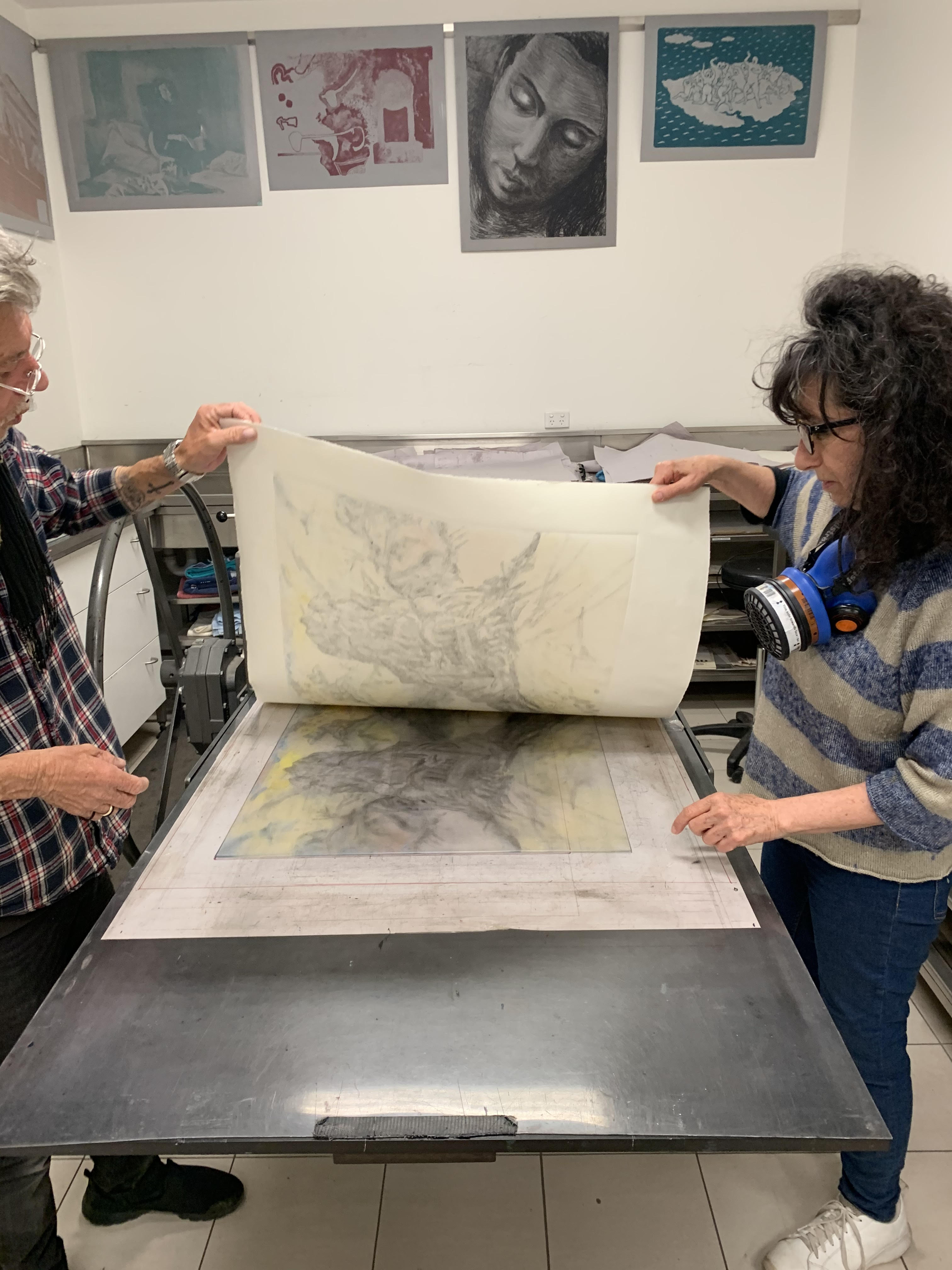
    These coloured monotypes were a prelude; small experiments, many discarded. I used a combination of watercolour, gauche and ink, then printed on Hahnmuhle Paper. I had my last and final residency at The Art Vault early in 2021. While there I worked on larger plates; being perspex they allowed me to see the image in reverse and also discover any stubborn, unresolved areas. This time using only coloured Charbonnel inks I covered parts of the plate with a roller creating different coloured areas, working intuitively with brushes to draw, tarlatan to wipe, feel and leave texture, cotton buds to discover small highlights, rags to wipe larger areas of light or wipe out whole areas and rework. Other times I began drawing the image, afterwards introducing colour. An awareness of my tools such as brush and roller marks are evident leaving an imprint of my process on the paper. They reflect a tactile response to my subject, helping me discover the abstract elements on the plate. Robert Watson, one of The Art Vault staff would assist in lining up the damp paper on the plate. Then we’d run it through the press. I always love the element of surprise when the paper is lifted off the plate. I’d invariably use the impression of a first print to make a second or a third, redrawing the plate and reworking it until I felt it was ready; my hope being that it had something of the feel of the ancient land that is Mungo, its past, its present, its beauty and its pain. Over time with the thirty odd images on my studio walls I continue to contemplate the works, deciding whether or not they are successful, completing some and reworking a few, but the majority I leave untouched.

    A version of this piece appeared previously in Tech Talk.