If you want to help improve and edit this listing, or have a suggestion, write to UNFURL.
Category: Information
Posts containing information that may interest subscribers
-
Australian arts on the internet in 2025
- Australian Poetry
- Australian Painters
- Australian Artists
- Patrick White
- Review articles of Australian poetry and poets
- Literature, Commentary & Cultural Review
- Academic & University-Affiliated Journals
- Visual Arts News & Criticism
- Poetry specific
- Performing Arts (Theatre, Music, Opera)
Australian Poetry
The past year has celebrated established mastery and urgent new voices, with David Brooks claiming the Prime Minister’s Literary Award. The sector also saw the release of the Best of Australian Poems 2025 anthology and a vibrant Poetry Month program fostering community engagement.
- David Brooks wins the 2025 Prime Minister’s Literary Award for Poetry
The $80,000 prize was awarded for his collection The Other Side of Daylight, praised for its profound literary contribution. - Release of the Best of Australian Poems 2025 Anthology
Edited by Nam Le and Jill Jones, this annual collection captures the diversity of the nation’s poetic output. - Evelyn Araluen releases new collection The Rot
The Stella Prize-winning author’s latest work explores the dying days of late-stage capitalism and settler colonial violence. - Red Room Poetry’s 2025 Poetry Month Festival
The August festival featured events like the Poem Forest Prize and the National Poetry Month Gala in Sydney. - ACT Literary Awards 2025 Winners Announced
Winners included Alisha Brown for the Finding Beauty Poetry Prize, celebrating emerging talent in the region.
Australian Painters
The 2025 awards season saw Julie Fragar and Jude Rae recognised for their exceptional portraiture and landscape work respectively. Major institutions also celebrated historical figures, with the National Gallery of Australia launching comprehensive retrospectives of modernist painters Ethel Carrick and Anne Dangar.
- Julie Fragar wins the 2025 Archibald Prize
The Brisbane artist won for Flagship Mother Multiverse (Justene), a portrait of her friend and fellow artist Justene Williams. - Jude Rae wins the 2025 Wynne Prize
Rae was awarded $50,000 for her landscape painting Pre-dawn sky over Port Botany container terminal. - Ethel Carrick and Anne Dangar Retrospectives at NGA
The National Gallery of Australia celebrates these two influential modernist painters with a major double exhibition. - Tony Albert named Artistic Director for Indigenous Triennial
The renowned painter and mixed-media artist led the curation of the 5th National Indigenous Art Triennial. - Vincent Namatjira features in After the Rain
The celebrated portraitist presented a series of intimate works for the Triennial, honouring fellow participating artists. - Arthur Boyd’s Artwork Returns to Bundanon
A major work by the celebrated painter has been loaned from the National Gallery to his former residence in NSW.
Australian Artists
The visual arts landscape was defined by the opening of the 5th National Indigenous Art Triennial and significant prize announcements. First Nations sovereignty and connection to Country were central themes, while contemporary artists like Gene A’Hern and Jonathan Jones received acclaim for their site-specific and abstract works.
- Opening of the 5th National Indigenous Art Triennial: After the Rain
This major exhibition features 10 immersive installations by First Nations artists, celebrating culture and resilience. - Gene A’Hern wins the 2025 Sulman Prize
A’Hern was awarded $40,000 for Sky painting, a bold gestural work inspired by the Blue Mountains. - Jonathan Jones featured in Bagan Bariwariganyan at Bundanon
Jones’s work appears alongside Aunty Julie Freeman in an exhibition exploring stories of the Gweagal and Wandiwandian peoples. - Alair Pambegan’s Flying Fox Installation
The artist created a suspended installation of over 500 flying foxes using traditional ochre for the Triennial. - Warraba Weatherall’s Mother-Tongue Installation
Weatherall presented a powerful new work exploring the relationship between body, language, and cultural heritage. - Ocean Photographer of the Year Exhibition
The Australian National Maritime Museum toured this exhibition to Bundanon, showcasing stunning aquatic photography.
Patrick White
Focus on Patrick White has been renewed through the prestigious literary award named in his honour, won this year by David Brooks. The playwrights’ award also recognised new talent, while fresh critical scholarship continues to examine White’s complex legacy and “dilemmas” in contemporary Australian culture.
- David Brooks wins the 2025 Patrick White Literary Award
The author received the $20,000 prize recognising his profound lifelong contribution to Australian literature and poetry. - Karolina Ristevski wins the 25th Patrick White Playwrights Award
Ristevski won for her play River Was Here, described as an accomplished and devastating portrait of human trauma. - New Book: On Patrick White’s Dilemmas by Vrasidas Karalis
A new critical work explores White’s “vernacular orality” and his status as a singular, uncompromising literary figure. - Nicholas Jose Essay: “Can we not live with Patrick White any longer?”
Jose reviews Karalis’s book and discusses the fading public memory of White’s image versus his enduring literary power. - Sydney Theatre Company celebrates 25 years of Playwrights Award
The 2025 ceremony honoured the award’s history of fostering new Australian drama in White’s name. - Patrick White’s Legacy in Environmental Thought
Judges cited White’s influence when awarding David Brooks, noting the shared thematic depth regarding nature and animals.
Review articles of Australian poetry and poets
- Guardian Review of Evelyn Araluen’s The Rot
Critics described the collection as a “fever dream” with an icily cold vision of injustice and capitalist decay. - The Guardian’s “Best Poetry Books of 2025”
The list highlights notable collections that pushed the boundaries of the form, including works by diverse Australian voices. - Review of The Other Side of Daylight by David Brooks
Praised for its “extraordinary care,” the book was celebrated for traversing histories of gender and nature with lyrical depth. - UWA Experts Share Best Books of 2025
Academic critics selected Evelyn Araluen’s The Rot as a standout text for its “unbearable complex tensions.” - Review of Best of Australian Poems 2025
The anthology is described as a “poetic snapshot” and barometer of the year, amplifying a diverse range of voices.
Literature, Commentary & Cultural Review
Australian Book Review (ABR)
Australia’s premier critical magazine, offering reviews, essays, commentaries, and new creative writing.
Editor: Peter Rose
https://www.australianbookreview.com.au/Sydney Review of Books (SRB)
A dedicated online literary journal focusing on long-form criticism and essays.
Editor: James Ley
https://sydneyreviewofbooks.com/Meanjin
Now defunct.
https://meanjin.com.au/The Monthly
A national magazine covering politics, society, and the arts, featuring long-form journalism and reviews.
Editor: Michael Williams
https://www.themonthly.com.au/Inside Story
An independent news and current affairs site featuring strong arts and culture analysis.
Editor: Peter Clarke
https://insidestory.org.au/Island Magazine
A premium literary magazine from Tasmania that publishes high-quality fiction, nonfiction, and poetry.
Editorial Manager: Jane Rawson
https://islandmag.com/Mascara Literary Review
A bi-annual journal focusing on contemporary writing by First Nations, culturally diverse, and neurodivergent artists.
Artistic Director: Michelle Cahill
https://www.mascarareview.com/Rochford Street Review
An independent online journal reviewing Australian literature, poetry, and small-press publications.
Editors: Mark Roberts and Linda Adair
https://rochfordstreetreview.com/Peril Magazine
An Asian-Australian arts and culture magazine publishing poetry, prose, and visual arts with a focus on diverse perspectives.
Chairperson: Lian Low
https://peril.com.au/
Academic & University-Affiliated Journals
Griffith Review
Operating out of Griffith University, this quarterly features public intellectual essays, reportage, and creative writing.
Editor: Carina Garland
https://www.griffithreview.com/Westerly Magazine
Based at the University of Western Australia, this journal publishes fiction, poetry, and essays with a focus on WA and Asia.
General Editor: Daniel Juckes
https://westerlymag.com.au/Southerly
One of Australia’s oldest literary journals, published by the English Association (Sydney).
Editor: Elizabeth McMahon
https://southerlyjournal.com.au/Axon: Creative Explorations
Published by the University of Canberra, this open-access journal focuses on poetry and creative practice-led research.
Editors: Jen Webb and Paul Hetherington
https://axonjournal.com.au/TEXT: Journal of Writing and Writing Courses
The journal of the Australasian Association of Writing Programs (AAWP), publishing scholarly articles on creative writing.
Managing Editors: Julienne van Loon and Ross Watkins
https://textjournal.scholasticahq.com/
Visual Arts News & Criticism
Art Monthly Australasia
The region’s flagship visual arts publication, providing critical discourse and exhibition reviews.
Editor: Michael Fitzgerald
https://www.artmonthly.org.au/Art Almanac
A monthly guide to galleries, news, and awards, serving as the essential “gallery guide” for the industry.
Editor: Melissa Pesa
https://www.art-almanac.com.au/ArtsHub
The primary trade publication for the Australian arts industry, covering news, jobs, and policy.
Content Director: George Dunford
https://www.artshub.com.au/Artist Profile
Focuses on the artists themselves, featuring in-depth studio interviews and photographic profiles.
Editor: Kon Gouriotis
https://artistprofile.com.au/Memo Review
Australia’s only weekly online review dedicated strictly to visual art exhibitions (primarily Melbourne/Sydney).
Editorial Team: Rotating academic and critic collective
https://memoreview.net/Runway Journal
An open-access digital platform for experimental art and criticism, managed by a rotating board of artists.
Co-Chairs (2025): Ena Grozdanic and Athanasios Lazarou
https://runway.org.au/un Projects (un Magazine)
An independent platform for contemporary art criticism, focusing on local dialogue and artist-led discourse.
Editor: Rotating guest editors per issue
https://unprojects.org.au/
Poetry specific
Cordite Poetry Review
A comprehensive online journal for Australian and international poetry and criticism.
Editor: Kent MacCarter
http://cordite.org.au/Australian Poetry Journal
The flagship publication of the national poetry body, publishing contemporary poems and critical essays.
Editor: Jacinta Le Plastrier (Publisher)
https://www.australianpoetry.org/
Performing Arts (Theatre, Music, Opera)
Limelight
Australia’s leading independent magazine for classical music, opera, and the performing arts.
Editor: Jo Litson
https://limelightmagazine.com.au/Australian Stage
Provides reviews and news covering theatre, opera, dance, and musicals across major capital cities.
Editor: Review team based
https://www.australianstage.com.au/
-

This happened …
Late in 2019, the Australian prime minister (marketing guru and shitty-pants Scott Morrison, ‘Sco-Mo’ to you) and his theatre assistants removed the federal administration’s arts appendix. One moment the word ‘Arts’ appeared somewhere in the names of government departments, and the next it had gone. Snip! And he chucked it in the bin.
Well, not exactly… ‘Arts’ was removed from a department’s name. To compensate, the yarts (as they are called in Australia) got an office. The Office of the Arts: <https://www.arts.gov.au/>. Never have the arts and government been so closely aligned than in this uniform resource locator.
There were articles in newspapers, outrage on the arts websites, and a long rash of angry emojis at the end of comments on Facebook.
The conservative government in Australia, returned at the May 2019 election by a slender margin, had decided a feature of the victory after-party would be to show the country’s angry, artistic child the door. “Your mother and I are tired of you! Always with your hand out, and never a word of thanks! Get a job!” And then, the ‘clap’ of the fly-screen door and a barely audible ‘clack’ of its tiny snib that seemed to say, “And don’t come back.”
Making art is a patient, lonely business. Making any progress seems to require years of practice and a bit of luck. Guidebooks and internet articles about being an artist, full of advice and clichés, pile up very quickly. Be yourself. Tell your truth. Talent is important, endurance essential. In the age of Instagram, sexy drawings and a bubble-butt are handy, but not essential (or so they say). Governments are not needed, but academic sinecures, supervising doctorates in novel-writing or discussions of queer theory, good if you can get them. When universities are financially sous vide, as they will be emerging from the 2020–forever pandemic, place bets at long odds that the arts will be favored for rehabilitation.
Governments, truth be told, don’t want to help. The governing classes are too busy ‘governing,’ which might as well mean lying, or fudging, or crying crocodile tears, or making a killing on the stock market, or taking a holiday in Hawai’i. To be the governor is to be the winner, the one who calls the shots, to be ‘the decider.’ From their high station in life these decider-governors have a role in narrating our social experience. They have a role we give them in legislating to tell us what is and is not important. (Have you noticed how very often our prime minister tells us what is important, and how very important is the very thing he is now saying?) It’s been a long time since governors of any stripe have shown us how the arts and sciences are important. Business, the economy, the stock market, and jobs are important. Wages growth, arts, and science, women, not so much.
UNFURL, my arts publishing project, was a reaction to artists’ reactions to government biases against the arts. Who needs government money anyway? I thought. It turns out, lots of people working in the arts need audiences, and it’s not easy to find and maintain audiences without government assistance. And, even within my narrow range of interests—writing and visual arts—the connections between arts activity and funding are deep. Poetry is not the malnourished tenant of the attic it was in Australia in the mid-1980s. The long lists of books for review and the number of official insignia on web pages are two possible measures of this.

At the same time, long-established literary magazines have had their funding cut. There is money for the arts, so long as it is going to places where the expenditure can be seen to be spent. Government wants the internet to sing “Hey, big spender!” while it cuts funding to Meanjin and others. It may be partly Meanjin’s fault: it has had nearly thirty years to figure out how to get its great store of content online for prospective subscribers to access, while the failure to do so begins to look like obstinacy.
UNFURL asked writers and artists to promote their own work to their own social media contacts while doing the same for other artists and writers: it’s a tool for artists to find new audiences and readers. UNFURL /1 started with a couple of writers I knew, Davide Angelo and James Walton, and a writer whom Angelo recommended, Anne Casey. Susan Wald, also published in the first UNFURL, was a painter whose work I liked and who had an exhibition planned for early 2020. I wanted to establish a process that could lead to unexpected choices. I would try not to make selections. I wanted artists to select or recommend other artists; and I wanted those artists to choose for themselves what they wanted to show with as little mediation as possible, encouraging people to show and to publish work they liked, and that might not have been selected (or grouped together) by an editor or curator.
Government wants the internet to sing “Hey, big spender!” while it cuts funding to Meanjin and others. It may be partly Meanjin’s fault: it has had nearly thirty years to figure out how to get its great store of content online for prospective subscribers to access, while the failure to do so begins to look like obstinacy.
It is more efficient to work on all one’s secret agendas simultaneously, so I should also admit my concern that belle-lettrist aesthetics (including the idea that poetry is language’s semantics incubator) and faux-modernist experimentation have combined to make poetry mostly irrelevant and a branch of marketing. —One only has to look at the writing being selected by the selectors to see that something is wrong with the practice of selection. As much as possible, I think, best to leave artists to make their own choices; and if there are mistakes, then, we’ll know who to blame.
And then, in March 2020 … then was the actual end of the world-as-we-knew-it. Those crazy ‘preppers’ I’ve made fun of started to look like visionaries. “Where the fuck is my bolthole, goddammit!?” and “How big is your bolthole, my friend!?” could have been common questions in some circles. People who could afford it, and had somewhere to go, did leave town. Gen-Xers lost their hospitality jobs, decided that they couldn’t afford their share house rent, and moved back ‘home.’ Artistes no longer had audiences. Artiste-enablers, stagehands, administrators and carpenters, were also out of work. COVID-19 put the arts and sciences back in the news.
The intersectional tragedy of pandemic and conservative political hostility to the lefty arts seemed to many like another opportunity to turn indifference into punishment. It was hard to disagree with pundits who have been cataloging this punishment.
UNFURL, possibly because of all this, has done quite well. By the time UNFURL /5 was released, writers and artists could expect to reach about two thousand readers within a couple of weeks of publication. (Each new UNFURL number provided a little boost to the previous issues, so that all the issues now clock up numbers in the thousands.) Eighty per cent of readers were in Australia, and most of the rest in the USA, Canada, UK and Ireland. The male:female ratio of readers was almost 50:50. The largest age group of readers was 18–35 years. (Though if everyone is ten years younger on the internet, maybe that’s 28–45.)
It’s difficult to read poetry on small-screen devices, so I did not expect UNFURL to be read on phones. The visual arts component of UNFURL is quite effective on phones and tablets, however. It seems likely that readers interested in the writing in UNFURL resorted to their desktops and printers. Sixty to seventy percent of downloads of UNFURL were to mobile and tablet devices.
I learned that women writers (poets) had a ‘stronger’ following among women readers than men had among readers of any kind. It was very apparent, with Gina Mercer, for example, that a very significant number of readers returned more often, subscribed more often, and were women.
I learned that women writers (poets) had a ‘stronger’ following among women readers than men had among readers of any kind. It was very apparent, with Gina Mercer, for example, that a very significant number of readers returned more often, subscribed more often, and were women.
I learned that social media isn’t the be-all and end-all of connecting with an audience. Old-fashioned email also works really well. Some artists and writers had no significant social media presence but used email effectively to communicate with friends and contacts.
I also learned that visual artists were, generally speaking, more enthusiastic and positive about using social media, and even better at basic stuff like answering messages. Visual artists be like Molly Bloom; writers be like Prince of Denmark.
I found that both writers and artists did things in UNFURL other publications might not permit (requiring, as they mostly do, first publication rights). Philip Salom published groupings of new and old poems. Alex Skovron published poems, prose, paintings, and drawings. Steven Warburton published a series of pictures about how one canvas evolved over several years. Robyn Rowland published poems and their translations into Turkish for her readers in Turkey. Ron Miller published a brief survey of his life’s work in space art.
All that and more to come.
Published first on the website of Stephen J Williams.
-
Unfurling guide
UNFURL is a publishing and social media project
that promotes writers and artists.- UNFURL publishes work you select.
- Other artists and writers join you to promote the UNFURL in which you are published.
- You return the favor when later UNFURLS are published.
- There are no fees or hidden costs.
- UNFURL does not want or use your social media contacts.
- New UNFURLS now reach thousands of readers; currently 80% of these are in Australia, and 20% in the USA, UK, and elsewhere.
- No contracts or obligations. It works on the honor system.
Contents of this guide
- What is UNFURL?
- Is it free for contributors and readers? (Yes)
- What can it do?
- How often will it be published?
- Does UNFURL have a home on the web?
- First steps
- Privacy
- Doing your bit to distribute UNFURL
- Links/URLs
- Writers and artists of UNFURL
What is UNFURL?
UNFURL is a publishing and social media project in which writers and artists distribute their work and reach new audiences by combining the power of their social media contacts.
Each UNFURL number (or edition) is an independently hosted web page—and that web page is linked to the UNFURL website where all the contributors’ biographical info is maintained.
The UNFURL website is at ‹unfurlwritingart.wordpress.com› or ‹unfurl.online›.
How have you been chosen to join it?
Someone liked what you were doing and suggested you.
UNFURL does not read submissions from writers or artists. UNFURL keeps an eye on quality by getting artists to recommend other artists.
Is it free for contributors and readers? (Yes)
UNFURL is free for readers and contributors. It costs you nothing to distribute or for readers to read.
Writers and artists who contribute co-operate to promote each other by offering to use whatever means they have to distribute the URLs of each edition as they become available. That could be as simple as sharing the link on your Facebook timeline, Instagram feed, website, or Twitter.
Each time a new edition of UNFURL is released the network of social media contacts widens.
Keeping UNFURL alive expands the audience for your work.
What can it do?
UNFURL can
- publish galleries of photos (JPGs)
- link Word and PDF files so that they can be read online or downloaded
- embed videos from YouTube or Vimeo
- link to audio files
- publish plain text that is not embedded in any other file (along with any associated photos, drawings, and illustrations)
- create visual stories that are a combination of pictures and words
- link to other destinations on the internet—your website(s), for example.
How often will it be published?
There will be new editions of UNFURL now and then, depending on how long it takes for contributors (and UNFURL editors … yes, it is possible there might one day be more of them) to herd all their cats. There are no deadlines.
Does UNFURL have a home on the web?
Yes. It is hosted on Stephen J. Williams’s website at ‹unfurlwritingart.wordpress.com›.
There is also a Facebook group which Facebook users can like and follow: ‹https://www.facebook.com/pg/unfurlhome›.
There is a list of links to various editions at ‹https://linktr.ee/unfurl›.
First steps
When you are invited to UNFURL you will also be invited to a Facebook contributor group. There’s information and discussion in it you may find useful. However, the basics are outlined here.
If you do not have a Facebook account, essential information is also sent to your email address.
It’s self-curation, people
You decide for yourself what you want to publish.
You can assume the only constraints are the editor’s time, and your work’s legality and decency (the last being a fiction entirely in the editor’s mind).
Occasionally the editor may try to prevent you making a mistake, and how things work out will depend on how you respond to friendly advice. You must approve of your contribution.
Visual artists, painters, photographers
For visual artists of any kind UNFURL is straightforward. It’s about images, still or moving. You have options.
- For complete personal control over the content, you could ‘host’ (or publish) all images yourself and UNFURL will simply link to your content.
This could be your website, or your Google Drive folder of photographs, or your Flickr account. You just need to keep in mind that if you manage it this way you have decided to opt out of the integrated presentation of images that UNFURL is offering to you.
In this case all UNFURL needs is an artist statement, biographical information, a photo of you, and the links to your work.
- Video art stays on YouTube or Vimeo and is embedded in UNFURL.
- If you want to create a gallery in an edition of UNFURL, gather your images together and prepare them in the following way:
Make the images as small as possible to display properly on a laptop or tablet computer — about 1200 pixels wide (at 72dpi) is usually enough.
Use a ‘lossy’ and compressible format like .JPG.
If possible, put a very discrete watermark on your images. (This helps to protect you against unauthorised re-use.)
Name the files with the title of the work, a date (year), and your name. Add the dimensions of the work, if you wish, or if you think it is relevant.
This is the format:
Title of work (medium, dimensions, YEAR) Artist’s Name.jpg
- When UNFURL captions the work, the work’s title will appear in italics, exactly as you have named the file. UNFURL simply drops the “.jpg” from the end.
- Send the images to ‹unfurleditor@gmail.com›.
- Include any text that you would like to appear as biographical information and/or artist’s statement.
- And include a picture of yourself, please, to go with the biographical information.
Writers
UNFURL hosts a document that contains your writing and biographical information.
UNFURL maintains the document in a format consistent with other writers.
Achieving this requires documents to be made with a Word template that uses automated styles to apply formatting to the text. If you are not used to doing this in Microsoft Word, or with working with Word online, the UNFURL editor will assist you.
- Create a text document of your own in whatever program you use for writing. (If you use a typewriter, congratulations and UNFURL will scan your pages and publish the images.)
- Make sure that document contains only basic formatting—i.e., bold or italics—and is preferably an RTF-type document (rich text format).
- You can send this document to UNFURL, or
- Cut and paste all the text you want to publish into the online document that UNFURL will embed directly into the edition in which your work will appear. You access that online document through a link that the UNFURL editor sends to you.
- If your writing contains complicated or fancy indenting (Go, poets!), do that last and in the final document.
- Microsoft Word cannot do everything. If you are imagining something ‘different,’ speak to the UNFURL editor and an attempt will (probably) be made to accommodate your pernicketiness.
- You will get to proof everything before it is published.
- For the time being the document you create will not be embedded in the UNFURL in which you are published. Instead, a link in the UNFURL will open a PDF that can be read online. UNFURL hopes that embedding will be possible in future.
The editing process for writers sometimes includes collaborating on an online version of the document to be published by UNFURL. It’s an uncomplicated way to work and exchange questions on a document without passing versions back and forth.
If the editor sends you a link, it will open in a browser and will save itself automatically when you make changes.
The online document appears slightly different on-screen than on paper. To view how the document will look if printed (or as a PDF), click on “View” in the menu bar …
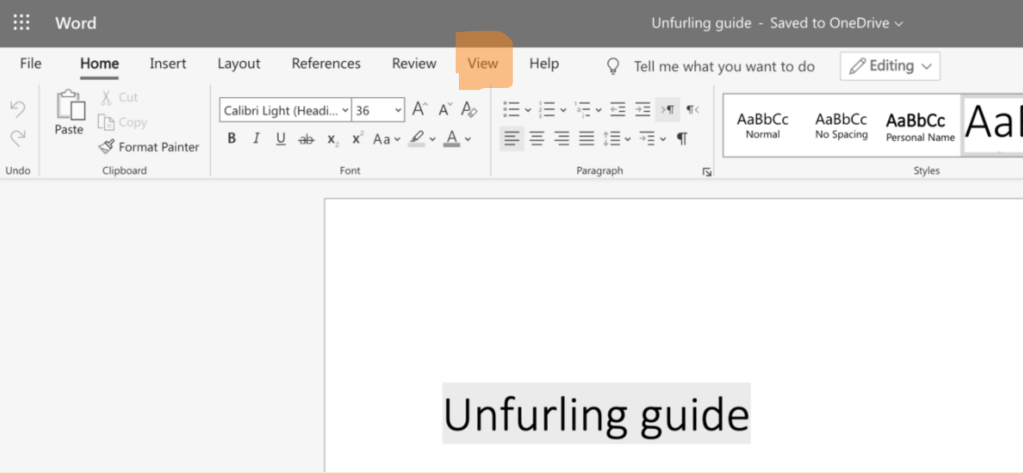
And then click on “Reading view” …

What then?
- You’ll be invited to join a Facebook ‘unfurl contributors’ group. If you are on Facebook, please join.
- If you do not have a Facebook account, congratulations. Stay connected through email — ‹unfurleditor@gmail.com›.
- Distribute the links to unfurl editions as they become available.
- Each new edition will have links to the previous editions, or to the UNFURL home page, so your contribution is not forgotten.
- Your contribution is listed at the unfurl home, and on various other sites, like linktr.ee, ‹https://linktr.ee/unfurl›.
- Every unfurl has its own bit.ly link so we can count readers and follow where those readers are.
- Use those links to promote your writing and art through your social media, your website, or even just by sending the link to your friends by email.
- You can link directly to your section of the UNFURL in which you are published.
Privacy
No social media contacts or email lists are exchanged or shared with or between UNFURL contributors. Lists and contacts remain private.
UNFURL maintains a separate subscriber list.
Doing your bit to distribute UNFURL
Every UNFURL has links to every other edition of UNFURL, so the work you have done to contribute to the publication always pays back. At the very least, your work remains in front of readers and the links in your ‘bio’ continue to provide a new avenue for readers to discover your work.
Distributing UNFURL is easy. Each edition has a link, and a related group of constantly updated reference pages on the web.
UNFURL uses bit.ly links so we can count how many people are reading your work.
- The contributor Facebook group will publish links to each edition and other materials you can use.
- You can put these links in Facebook posts, with your own recommendation or with the few words provided in the Facebook contributor group.
- If you do not have a Facebook account, the links will be sent to your email address. (The emailed information is sent to everyone anyway.)
- Use Twitter to distribute the link. Add a few relevant hashtags, and/or send it directly to people or groups you think may find it interesting.
- Instagram is not a highly effective tool for working with links, but it is worth a try if you have an account. Use one of your own graphics, or one from UNFURL, and put the bit.ly link in the first comment, along with appropriate hashtags.
- You can use your own email contact lists to send the UNFURL link to your friends and family.
- You can put the UNFURL link on your web page, in the bio section, or listed as another place to view or read your work.
Links/URLs
- The UNFURL home ‹unfurlwritingart.wordpress.com› or ‹http://bit.ly/unfurlweb›
- UNFURLED (an index of contributors already unfurled) ‹http://bit.ly/unfurls›
- UNFURL /1 ‹http://bit.ly/unfurl1›
- UNFURL /2 ‹http://bit.ly/unfurl2›
- UNFURL /3 ‹http://bit.ly/unfurl3›
- UNFURL /4 ‹http://bit.ly/unfurl4a›
- UNFURL /5 ‹http://bit.ly/unfurl5›
- UNFURL /6 ‹http://bit.ly/unfurl6›
Artists and writers who have joined UNFURL
- Davide Angelo
- James Walton
- Anne Casey
- Susan Wald
- Alex Skovron
- Gina Mercer
- Steve Cox
- Les Wicks
- Nigel Cross
- Stuart Barnes
- Peter Lach-Newinsky
- Robyn Rowland AO
- Ali Whitelock
- Lee James Shott
- Sebastian Steensen
- Steven Warburton
- Gloria Stern
- Marcia Jacobs
- Ellen Shelley
- Datsun Tran
- Philip Salom
- Ron Miller
- Tara Mokhtari
- Anna Jacobson
- Joyce Lee
- Ryota Hisanabe
 UNFURL