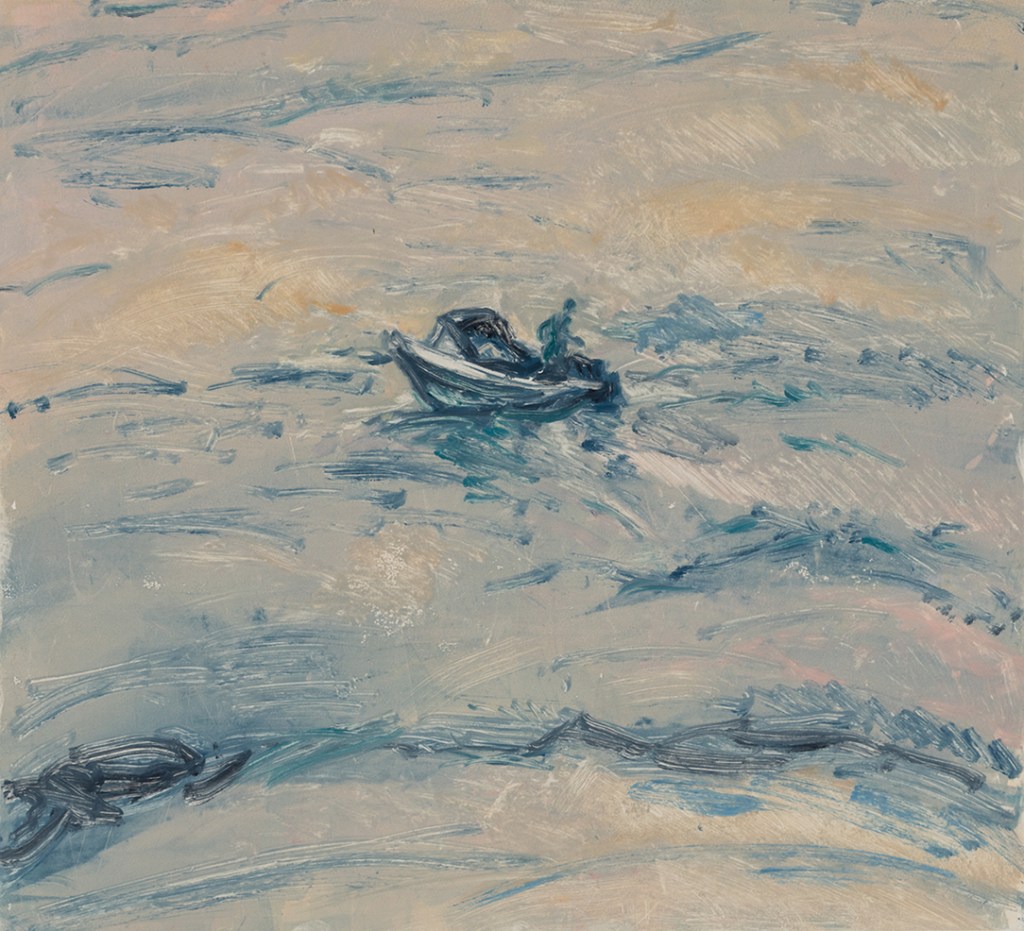
Susan Wald’s Queenscliff Monotypes is opening on 26 March 2026, and continues until 13 April 2026, at Queenscliff Gallery. She will be at the gallery on Sunday 29 March 2026 to talk about the work. Details below …
The past year has celebrated established mastery and urgent new voices, with David Brooks claiming the Prime Minister’s Literary Award. The sector also saw the release of the Best of Australian Poems 2025 anthology and a vibrant Poetry Month program fostering community engagement.
The 2025 awards season saw Julie Fragar and Jude Rae recognised for their exceptional portraiture and landscape work respectively. Major institutions also celebrated historical figures, with the National Gallery of Australia launching comprehensive retrospectives of modernist painters Ethel Carrick and Anne Dangar.
The visual arts landscape was defined by the opening of the 5th National Indigenous Art Triennial and significant prize announcements. First Nations sovereignty and connection to Country were central themes, while contemporary artists like Gene A’Hern and Jonathan Jones received acclaim for their site-specific and abstract works.
Focus on Patrick White has been renewed through the prestigious literary award named in his honour, won this year by David Brooks. The playwrights’ award also recognised new talent, while fresh critical scholarship continues to examine White’s complex legacy and “dilemmas” in contemporary Australian culture.
Australian Book Review (ABR) Australia’s premier critical magazine, offering reviews, essays, commentaries, and new creative writing. Editor: Peter Rose https://www.australianbookreview.com.au/
Sydney Review of Books (SRB) A dedicated online literary journal focusing on long-form criticism and essays. Editor: James Ley https://sydneyreviewofbooks.com/
The Monthly A national magazine covering politics, society, and the arts, featuring long-form journalism and reviews. Editor: Michael Williams https://www.themonthly.com.au/
Inside Story An independent news and current affairs site featuring strong arts and culture analysis. Editor: Peter Clarke https://insidestory.org.au/
Island Magazine A premium literary magazine from Tasmania that publishes high-quality fiction, nonfiction, and poetry. Editorial Manager: Jane Rawson https://islandmag.com/
Mascara Literary Review A bi-annual journal focusing on contemporary writing by First Nations, culturally diverse, and neurodivergent artists. Artistic Director: Michelle Cahill https://www.mascarareview.com/
Rochford Street Review An independent online journal reviewing Australian literature, poetry, and small-press publications. Editors: Mark Roberts and Linda Adair https://rochfordstreetreview.com/
Peril Magazine An Asian-Australian arts and culture magazine publishing poetry, prose, and visual arts with a focus on diverse perspectives. Chairperson: Lian Low https://peril.com.au/
Academic & University-Affiliated Journals
Griffith Review Operating out of Griffith University, this quarterly features public intellectual essays, reportage, and creative writing. Editor: Carina Garland https://www.griffithreview.com/
Westerly Magazine Based at the University of Western Australia, this journal publishes fiction, poetry, and essays with a focus on WA and Asia. General Editor: Daniel Juckes https://westerlymag.com.au/
Southerly One of Australia’s oldest literary journals, published by the English Association (Sydney). Editor: Elizabeth McMahon https://southerlyjournal.com.au/
Axon: Creative Explorations Published by the University of Canberra, this open-access journal focuses on poetry and creative practice-led research. Editors: Jen Webb and Paul Hetherington https://axonjournal.com.au/
TEXT: Journal of Writing and Writing Courses The journal of the Australasian Association of Writing Programs (AAWP), publishing scholarly articles on creative writing. Managing Editors: Julienne van Loon and Ross Watkins https://textjournal.scholasticahq.com/
Visual Arts News & Criticism
Art Monthly Australasia The region’s flagship visual arts publication, providing critical discourse and exhibition reviews. Editor: Michael Fitzgerald https://www.artmonthly.org.au/
Art Almanac A monthly guide to galleries, news, and awards, serving as the essential “gallery guide” for the industry. Editor: Melissa Pesa https://www.art-almanac.com.au/
ArtsHub The primary trade publication for the Australian arts industry, covering news, jobs, and policy. Content Director: George Dunford https://www.artshub.com.au/
Artist Profile Focuses on the artists themselves, featuring in-depth studio interviews and photographic profiles. Editor: Kon Gouriotis https://artistprofile.com.au/
Memo Review Australia’s only weekly online review dedicated strictly to visual art exhibitions (primarily Melbourne/Sydney). Editorial Team: Rotating academic and critic collective https://memoreview.net/
Runway Journal An open-access digital platform for experimental art and criticism, managed by a rotating board of artists. Co-Chairs (2025): Ena Grozdanic and Athanasios Lazarou https://runway.org.au/
un Projects (un Magazine) An independent platform for contemporary art criticism, focusing on local dialogue and artist-led discourse. Editor: Rotating guest editors per issue https://unprojects.org.au/
Poetry specific
Cordite Poetry Review A comprehensive online journal for Australian and international poetry and criticism. Editor: Kent MacCarter http://cordite.org.au/
Australian Poetry Journal The flagship publication of the national poetry body, publishing contemporary poems and critical essays. Editor: Jacinta Le Plastrier (Publisher) https://www.australianpoetry.org/
Performing Arts (Theatre, Music, Opera)
Limelight Australia’s leading independent magazine for classical music, opera, and the performing arts. Editor: Jo Litson https://limelightmagazine.com.au/
Australian Stage Provides reviews and news covering theatre, opera, dance, and musicals across major capital cities. Editor: Review team based https://www.australianstage.com.au/
Majoring in Painting at Victoria College, Prahran 1989-91 I enrolled in printmaking as an elective. From the Head of Printmaking, John Scurry and lecturer Simon Cooper, I learnt different techniques discovering that this was a medium I could experiment with and one that could inform and feed into my painting. I developed a love of the process and later began to concentrate mainly on monotypes; a combination of drawing, painting and printmaking, they allowed me a more felt response when making and reacting to marks on the plate. Facilitating rapid experimentation and subtle development of the image, the monotype has become an integral part of my art practice.
On a first encounter with Degas’ monotypes over thirty years ago, I felt driven to spend countless hours poring over his sooty, inky blacks; his drawing and abstraction leaving their indelible mark. Degas distilled everything down to its essence, reflecting life and the human condition. Powerful images that had me enthralled, he more than any other artist influenced and prodded my desire and curiosity to experiment with the medium.
The Australian Print Workshop (APW) provided a great space for working in an environment where everyone was making and engaging in a conversation about prints. I’d go there for long stints after initial drawings and usually before I’d begin painting in my studio. Since 2014, I’ve had five wonderful and productive residencies at The Art Vault, the last three working on a body of work responding to Lake Mungo. After making black and white monotypes, a number of them exhibited in solo shows at the Mildura Arts Centre (MAC) in 2020, and then at Printmaker Gallery (PG) 2021. Working in black and white helped make some sense of the structure, form and mood. Preparing the plate, I would either cover it completely or partially with ink, drawing, wiping or adding to the image with tools and rags until it spoke to me of the land. After printing a darker first image I proceeded to work back into the ghost image on the plate. Colour being integral to Mungo I experimented further. I had been overwhelmed by the colour shifts – red to burnt orange, blue grey and yellow. In my mind bringing myself back to the land, I would often refer to sketches and photos both made and taken in my time there. I worked using memory and imagination to feel the subtleties and build-up of coloured layers of sand and mud pinnacles at Red Top and the Walls of China, but also on images of trees struggling to survive in the sand and the mud, and the sometimes still, sometimes windy, blue or grey clouds and the colour reflected skies.
Susan Wald
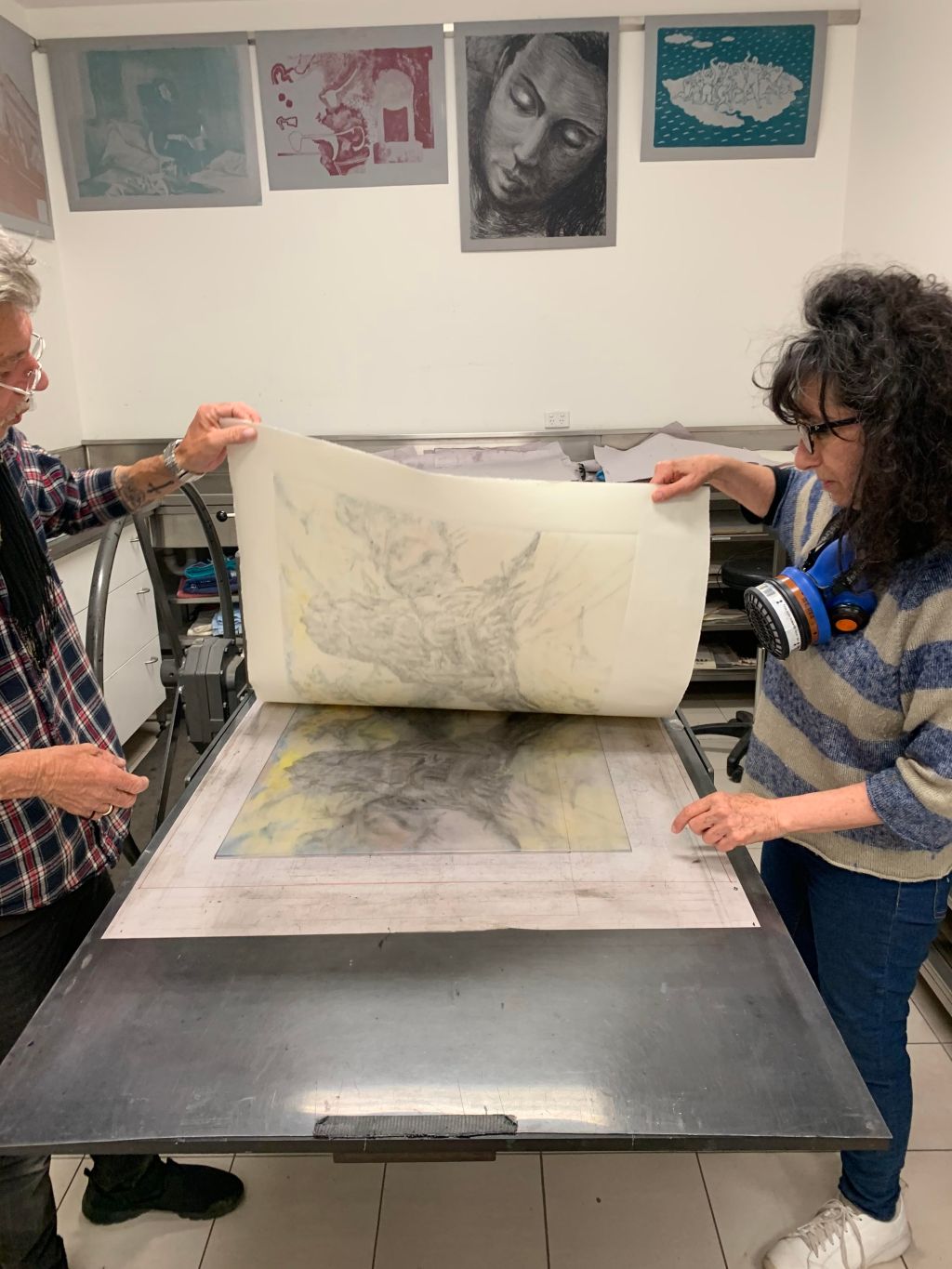
These coloured monotypes were a prelude; small experiments, many discarded. I used a combination of watercolour, gauche and ink, then printed on Hahnmuhle Paper. I had my last and final residency at The Art Vault early in 2021. While there I worked on larger plates; being perspex they allowed me to see the image in reverse and also discover any stubborn, unresolved areas. This time using only coloured Charbonnel inks I covered parts of the plate with a roller creating different coloured areas, working intuitively with brushes to draw, tarlatan to wipe, feel and leave texture, cotton buds to discover small highlights, rags to wipe larger areas of light or wipe out whole areas and rework. Other times I began drawing the image, afterwards introducing colour. An awareness of my tools such as brush and roller marks are evident leaving an imprint of my process on the paper. They reflect a tactile response to my subject, helping me discover the abstract elements on the plate. Robert Watson, one of The Art Vault staff would assist in lining up the damp paper on the plate. Then we’d run it through the press. I always love the element of surprise when the paper is lifted off the plate. I’d invariably use the impression of a first print to make a second or a third, redrawing the plate and reworking it until I felt it was ready; my hope being that it had something of the feel of the ancient land that is Mungo, its past, its present, its beauty and its pain. Over time with the thirty odd images on my studio walls I continue to contemplate the works, deciding whether or not they are successful, completing some and reworking a few, but the majority I leave untouched.
A version of this piece appeared previously in Tech Talk.
Late in 2019, the Australian prime minister (marketing guru and shitty-pants Scott Morrison, ‘Sco-Mo’ to you) and his theatre assistants removed the federal administration’s arts appendix. One moment the word ‘Arts’ appeared somewhere in the names of government departments, and the next it had gone. Snip! And he chucked it in the bin.
Well, not exactly… ‘Arts’ was removed from a department’s name. To compensate, the yarts (as they are called in Australia) got an office. The Office of the Arts: <https://www.arts.gov.au/>. Never have the arts and government been so closely aligned than in this uniform resource locator.
There were articles in newspapers, outrage on the arts websites, and a long rash of angry emojis at the end of comments on Facebook.
The conservative government in Australia, returned at the May 2019 election by a slender margin, had decided a feature of the victory after-party would be to show the country’s angry, artistic child the door. “Your mother and I are tired of you! Always with your hand out, and never a word of thanks! Get a job!” And then, the ‘clap’ of the fly-screen door and a barely audible ‘clack’ of its tiny snib that seemed to say, “And don’t come back.”
Making art is a patient, lonely business. Making any progress seems to require years of practice and a bit of luck. Guidebooks and internet articles about being an artist, full of advice and clichés, pile up very quickly. Be yourself. Tell your truth. Talent is important, endurance essential. In the age of Instagram, sexy drawings and a bubble-butt are handy, but not essential (or so they say). Governments are not needed, but academic sinecures, supervising doctorates in novel-writing or discussions of queer theory, good if you can get them. When universities are financially sous vide, as they will be emerging from the 2020–forever pandemic, place bets at long odds that the arts will be favored for rehabilitation.
Governments, truth be told, don’t want to help. The governing classes are too busy ‘governing,’ which might as well mean lying, or fudging, or crying crocodile tears, or making a killing on the stock market, or taking a holiday in Hawai’i. To be the governor is to be the winner, the one who calls the shots, to be ‘the decider.’ From their high station in life these decider-governors have a role in narrating our social experience. They have a role we give them in legislating to tell us what is and is not important. (Have you noticed how very often our prime minister tells us what is important, and how very important is the very thing he is now saying?) It’s been a long time since governors of any stripe have shown us how the arts and sciences are important. Business, the economy, the stock market, and jobs are important. Wages growth, arts, and science, women, not so much.
UNFURL, my arts publishing project, was a reaction to artists’ reactions to government biases against the arts. Who needs government moneyanyway? I thought. It turns out, lots of people working in the arts need audiences, and it’s not easy to find and maintain audiences without government assistance. And, even within my narrow range of interests—writing and visual arts—the connections between arts activity and funding are deep. Poetry is not the malnourished tenant of the attic it was in Australia in the mid-1980s. The long lists of books for review and the number of official insignia on web pages are two possible measures of this.
At the same time, long-established literary magazines have had their funding cut. There is money for the arts, so long as it is going to places where the expenditure can be seen to be spent. Government wants the internet to sing “Hey, big spender!” while it cuts funding to Meanjin and others. It may be partly Meanjin’s fault: it has had nearly thirty years to figure out how to get its great store of content online for prospective subscribers to access, while the failure to do so begins to look like obstinacy.
UNFURL asked writers and artists to promote their own work to their own social media contacts while doing the same for other artists and writers: it’s a tool for artists to find new audiences and readers. UNFURL /1 started with a couple of writers I knew, Davide Angelo and James Walton, and a writer whom Angelo recommended, Anne Casey. Susan Wald, also published in the first UNFURL, was a painter whose work I liked and who had an exhibition planned for early 2020. I wanted to establish a process that could lead to unexpected choices. I would try not to make selections. I wanted artists to select or recommend other artists; and I wanted those artists to choose for themselves what they wanted to show with as little mediation as possible, encouraging people to show and to publish work they liked, and that might not have been selected (or grouped together) by an editor or curator.
Government wants the internet to sing “Hey, big spender!” while it cuts funding to Meanjin and others. It may be partly Meanjin’s fault: it has had nearly thirty years to figure out how to get its great store of content online for prospective subscribers to access, while the failure to do so begins to look like obstinacy.
It is more efficient to work on all one’s secret agendas simultaneously, so I should also admit my concern that belle-lettrist aesthetics (including the idea that poetry is language’s semantics incubator) and faux-modernist experimentation have combined to make poetry mostly irrelevant and a branch of marketing. —One only has to look at the writing being selected by the selectors to see that something is wrong with the practice of selection. As much as possible, I think, best to leave artists to make their own choices; and if there are mistakes, then, we’ll know who to blame.
And then, in March 2020 … then was the actual end of the world-as-we-knew-it. Those crazy ‘preppers’ I’ve made fun of started to look like visionaries. “Where the fuck is my bolthole, goddammit!?” and “How big is your bolthole, my friend!?” could have been common questions in some circles. People who could afford it, and had somewhere to go, did leave town. Gen-Xers lost their hospitality jobs, decided that they couldn’t afford their share house rent, and moved back ‘home.’ Artistes no longer had audiences. Artiste-enablers, stagehands, administrators and carpenters, were also out of work. COVID-19 put the arts and sciences back in the news.
The intersectional tragedy of pandemic and conservative political hostility to the lefty arts seemed to many like another opportunity to turn indifference into punishment. It was hard to disagree with pundits who have been cataloging this punishment.
UNFURL, possibly because of all this, has done quite well. By the time UNFURL /5 was released, writers and artists could expect to reach about two thousand readers within a couple of weeks of publication. (Each new UNFURL number provided a little boost to the previous issues, so that all the issues now clock up numbers in the thousands.) Eighty per cent of readers were in Australia, and most of the rest in the USA, Canada, UK and Ireland. The male:female ratio of readers was almost 50:50. The largest age group of readers was 18–35 years. (Though if everyone is ten years younger on the internet, maybe that’s 28–45.)
It’s difficult to read poetry on small-screen devices, so I did not expect UNFURL to be read on phones. The visual arts component of UNFURL is quite effective on phones and tablets, however. It seems likely that readers interested in the writing in UNFURL resorted to their desktops and printers. Sixty to seventy percent of downloads of UNFURL were to mobile and tablet devices.
I learned that women writers (poets) had a ‘stronger’ following among women readers than men had among readers of any kind. It was very apparent, with Gina Mercer, for example, that a very significant number of readers returned more often, subscribed more often, and were women.
I learned that women writers (poets) had a ‘stronger’ following among women readers than men had among readers of any kind. It was very apparent, with Gina Mercer, for example, that a very significant number of readers returned more often, subscribed more often, and were women.
I learned that social media isn’t the be-all and end-all of connecting with an audience. Old-fashioned email also works really well. Some artists and writers had no significant social media presence but used email effectively to communicate with friends and contacts.
I also learned that visual artists were, generally speaking, more enthusiastic and positive about using social media, and even better at basic stuff like answering messages. Visual artists be like Molly Bloom; writers be like Prince of Denmark.
I found that both writers and artists did things in UNFURL other publications might not permit (requiring, as they mostly do, first publication rights). Philip Salom published groupings of new and old poems. Alex Skovron published poems, prose, paintings, and drawings. Steven Warburton published a series of pictures about how one canvas evolved over several years. Robyn Rowland published poems and their translations into Turkish for her readers in Turkey. Ron Miller published a brief survey of his life’s work in space art.
Datsun Tran is an Australian multidisciplinary artist, his work primarily features the natural world, though it is about us, the human story. His work has explored themes of conflict and utopia, filtered through the lens of what we have in common, rather than what separates us.
Tran has exhibited extensively in Australia, as well as North America, Asia and Europe. He has had over twenty-five solo and group shows, exhibited in over thirty art fairs, and has been a finalist in over thirty-five art prizes.
Gloria Stern is a visual artist currently living and working in Melbourne, Australia. She grew up in Melbourne and originally trained in Graphic Design. After working in the design industry for several years both in England and Australia, she then switched across to full time painting. Since 1996, she has had 12 solo exhibitions and has been included in numerous group shows.
Gloria’s paintings have been acquired for private collections in Australia, UK, USA, and New Zealand. Her works are also featured in the collections of Cowan Design, Melbourne, and the City of Boroondara Collection, Melbourne.
I have always been interested in exploring both figuration and abstraction in my painting, however, over the last couple of years, I made a conscious effort to remove the figurative element from my work in order to explore spatial relationships, colour and atmosphere within abstraction more deeply. This body of work led up to my last solo exhibition “Altered Space” in 2019. Since then, my interest in the figure is returning, but I think, in a less literal way than before. I am currently exploring ways of using figurative elements as more integrated abstract shapes, that allow for a freer interpretation of meaning.
Steven Warburton is currently working (in Emerald) and exhibiting in Melbourne, Australia. Since completing a Fine Arts degree at Monash University, Steve has exhibited widely, in group and solo exhibitions. His paintings and drawings are held in collections Australia-wide and internationally.
As an artist’s work is a reflection of his or her emotions, ideals, thoughts and influences, it is necessary to understand the importance the work plays in the artist’s life.
My work is the direct result of things that I have borne witness to, overheard in conversations, observed in the media or dreamt. It reflects my right to express my thoughts, in a way I hope will be accessible to the viewer, both aesthetically and literally.
As the world around us changes, the environment, the politics, our society, thus my imagery changes too.




 UNFURL